Sunday, 29 October 2023

Comainn Eachdraidh - historical societies in the Western Isles

At the BIFHSGO Conference earlier today I had great fun, alongside Highland archivisit Lorna Steele-McGinn, in answering questions to do with research in Scotland's Highlands and Islands. 

One type of resource that a lot of folk don't know about is the historical societies that exist in the Western Isles, rather than family history societies, which are known in Gaelic as the comainn eachdraidh (comann eachdraidh singular, sometimes also written as comunn eachdraidh). Many islands have a comann eachdraidh, whilst some have more than one. 

The following is a list as drawn from the Hebridean Connections platform at https://www.hebrideanconnections.com:

Comunn Eachdraidh Cheann a' Loch (CECL)
Kinloch Historical Society

Comann Coimhearsnachd Bheàrnaraigh (CCB)
Berneray Community Association

Comunn Eachdraidh na Pàirc (CEP)
Pairc Historical Society

Comunn Eachdraidh Bheàrnaraigh (CEBH)
Berneray Historical Society

Comann Eachdraidh Bharabhais agus Bhrù (CEBB)
Barvas and Brue Historical Society

Comann Glèidhteachais Teampall na Trianaid (CGTNT)
Teampall na Trianaid Conservation Association

Comunn Eachdraidh Ùig (CEU)
Uig Historical Society

Comann Eachdraidh Uibhist a Tuath (CEUT)
North Uist Historical Society

Comunn Eachdraidh Nis (CEN)
Ness Historical Society

Comann Eachdraidh Chàrlabhaigh (CEC)
Carloway Historical Society

Comann Eachdraidh an Taobh Siar (CEATS)
West Side Historical Society

Comann Eachdraidh Sgìre Bheàrnaraigh (CEBL)
Bernera Historical Society

Comann Eachdraidh Cheann a Tuath nan Loch (CECTL)
North Lochs Historical Society

Càirdean Carragh Cuimhne Bheinn nam Faoghla (CCCBF)
Friends of Benbecula War Memorial

Comann Eachdraidh Tholastaidh bho Thuath (CET)
North Tolsta Historical Society

Urras Leabhraichean nan Eilean (IBT)
The Islands Book Trust

Links for these are available via the Hebrides Connections page, as above. 

Other comainn eachdraidh include:

Comann Eachdraidh Uibhist a Deas (South Uist)
https://outerhebridesheritage.org.uk/community-heritage/south-uist-historical-society/

Comann Eachdraidh Barraigh agus Bhatarsaigh (Barra and Vatersay)                                             https://www.barraheritagecentre.com

Comann Eachdraidh Èirisgeigh (Eriskay)
https://www.eriskayheritage.scot

If you have ancestors from the Western Isles, do try these societies for assistance, and don't forget also the Seallam! group on Harris also, that can help - details via their Hebrides People website at https://hebridespeople.com.

Chris

Order Tracing Your Belfast Ancestors in the UK at https://bit.ly/BelfastAncestors. Also available - Tracing Your Irish Ancestors Through Land Records, Sharing Your Family History Online, Tracing Your Scottish Family History on the Internet, Tracing Your Irish Family History on the Internet (2nd ed), and Tracing Your Scottish Ancestry Through Church and State Records - to purchase, please visit https://bit.ly/ChrisPatonPSbooks. For purchase in tthe USA visit https://www.penandswordbooks.com. Further news published daily on The Scottish GENES Facebook page, on Threads at @scottishgenesblog and via Mastodon at https://mastodon.scot/@ScottishGENES.


Friday, 27 October 2023

Scottish witchcraft cases resources

Some online resources to research Scottish witchcraft cases: 

FindmyPast (www.findmypast.co.uk) added the following collectiona couple of years back:

Scotland, Names of Witches 1658
In this small but spooky collection, you’ll find details on some of those accused of witchcraft in early modern Scotland. 1563’s Witchcraft Act made consorting with witches or taking part in witchcraft a crime punishable by death in Scotland. Around 1,500 people were executed, most of them women, until the last Scottish witch trial in 1727.
(Source: Wellcome Collection, Names of the Witches (in Scotland), 1658, MS.3658)

In 2016 Ancestry (www.ancestry.co.uk) previously released the same collection:

Scotland, Names of Witches, 1658
http://search.ancestry.co.uk/search/db.aspx?dbid=61099
Source: Names of Witches in Scotland. Wellcome Library, London, England.

About Scotland, Names of Witches, 1658

The passing of the Scottish Witchcraft Act in 1563 made witchcraft, or consulting with witches, capital crimes in Scotland. It is estimated that between three and five thousand women were publicly accused of being witches in 16th and 17th century Scotland, a much higher number than neighbouring England. Some men were also accused of witchcraft during this period, however, the number of women persecuted was far larger.

The outbreak of witch-hunting in the years 1658-1662, the period in which this list of names was created, is generally agreed to represent the high water mark of Scottish persecution.

Within this collection, you will be able to find details of the accused's name and resident town.

(Image: Wellcome Library)

There was a bit more on the book's release on Scottish Legal news at https://web.archive.org/web/20161028130410/http://www.scottishlegal.com/2016/10/27/book-listing-those-accused-of-witchcraft-in-17th-century-scotland-digitised/

Don't forget the University of Edinburgh's Survey of Scottish Witchcraft website at http://witches.shca.ed.ac.uk. There is more about this project at https://en.wikipedia.org/wiki/Survey_of_Scottish_Witchcraft

Chris

Order Tracing Your Belfast Ancestors in the UK at https://bit.ly/BelfastAncestors. Also available - Tracing Your Irish Ancestors Through Land Records, Sharing Your Family History Online, Tracing Your Scottish Family History on the Internet, Tracing Your Irish Family History on the Internet (2nd ed), and Tracing Your Scottish Ancestry Through Church and State Records - to purchase, please visit https://bit.ly/ChrisPatonPSbooks. For purchase in tthe USA visit https://www.penandswordbooks.com. Further news published daily on The Scottish GENES Facebook page, on Threads at @scottishgenesblog and via Mastodon at https://mastodon.scot/@ScottishGENES.

Ghostbusting in Inveraray

In late 2009 I was invited to go on a ghosthunting event at Inveraray Jail in Argyll by a tour operator. I wrote up my escapades for two magazines, a short piece for Scottish Memories, and a longer piece for Discover my Past Scotland. As we get closer to Hallowe'en, here's the article from DMPS (with a couple of links updated) - enjoy!

Ghostbusting in Inveraray

Chris Paton goes in search of the paranormal at a 19th century jail…

A few years ago a discussion was aired in British genealogical magazines about whether the use of mediums was a valid tool for family history research. Personally speaking, I don’t believe in ghosts at all and am a complete sceptic, so have never paid attention to any of this in a professional capacity.

I should add, though, that this actually flies in the face of family tradition! In my mother’s paternal ancestry, the Grahams were members of a spiritualist church on Belfast’s Shankill Road. My two times great grandfather, Edwin Graham (see pic on right - he's on the back row at the right), was in fact the secretary of the Ulster Christian Spiritualists Society and rather dramatically made the newspapers across the UK in 1926 when he organised an experiment in Belfast City Cemetery to photograph a funeral, inviting well over a hundred spiritualists to bring their cameras along to take photographs as the deceased was lowered into the ground. Edwin believed that it might have been possible to capture images of other spirits in attendance, and a press report later claimed that he had been convinced that he had seen the ghost of his brother at the graveside. I have no doubt Edwin must have seen a spirit of some kind on that day, though whether we are taking the floaty, spooky kind is in my mind very open to question.

Nevertheless, having said all of that, I dearly want to believe that there is something true about the paranormal. After all, wouldn’t life be just ever so much more exciting? My wife and I regularly watched the television series “Most Haunted”, myself as an enthusiastic sceptic – how did they do that, what could have caused that noise? – and my wife with a view that there could be more to it than meets the eye. So it was with a great deal of enthusiasm that we recently took up an invitation from Ghost Events Scotland to attend one of its ghost hunting vigils at Inveraray Castle.

Coincidentally, “Most Haunted” had actually visited both Inveraray Jail and the town’s nearby castle just a few weeks prior to our invitation, recording all sorts of apparent poltergeists and spooks. The Ghost Events Scotland night would be a similar sort of endeavour, with séances, Ouija boards, and a friendly medium to guide us around. Would things truly go bump in the night - or would we just keep bumping into things?


Inveraray Jail
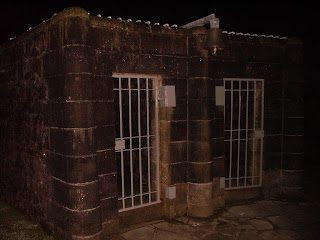
Located on the shores of Loch Fyne in the heart of Campbell country, Inveraray Jail was first opened for business in 1820 as a prison of eight cells, where both male and female criminals, and debtors, could be locked up after a trial in the adjacent courtroom. A new prison block with a further twelve cells was opened in 1848, and the whole operation continued until 1889 when it was finally closed. Having been to the prison several times before, it was never hard to imagine the horrendous lives of the prisoners who resided there. From a genealogical point of view, the museum also provides many useful resources for family historians, not least of which is its online database of prisoners located at http://www.inverarayjail.co.uk/our-history/, providing information on those convicted, their crimes and in some cases details of transportation, though it does not provide case notes for any of those said to still be haunting the place! Prisoners faced a gruesome time within, having limited facilities, poor food, a small courtyard for exercise, and the occasional whipping with the birch.

Arriving at the Jail at 10.00pm on the Saturday evening of the event, we were hastily gathered into a room for a briefing on the forthcoming six hour vigil, which initially started with some ‘training’. This was in the form of acquiring ‘protection’ against any prospective baddies out to get us through the vigil, mainly by imagining some sort of white light around us – an interesting start, I thought. We were divided into two teams, and our team, led by a lady called Linda claiming to be a medium, was soon being escorted to the prison’s new block.

Once inside, with all the lights switched off, Linda apparently began to sense the spirits of a John and Hugh Campbell pacing up and down their cell. They seemed fairly quiet to me, so instead I began to wonder what life must have been like each night for the prisoners, particularly in the winter with its short daylight hours. It was minus eight degrees outside, and not much warmer inside. As we left the ground floor, Linda announced that we were now being followed by a violent sheep stealer called Robert Stewart. Not one for having my sheep stolen, I quickly moved upstairs with everybody else. (In fact, a consultation of the database after the event did reveal that a person of that name from Glencoe was imprisoned in 1855 for 15 months for sheep stealing from three farms.)
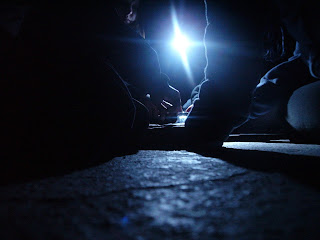
In an upstairs room, we were then asked to try to talk to spirits using a Ouija board. People get awfully spooked by Ouija boards, but not being a believer in the paranormal, I did not worry about having a go! I duly stuck my finger firmly on the glass, and after several minutes I was soon receiving the message loudly and clearly that my finger was getting very cold, but nothing more. Clearly 19th century prison discipline must have worked, because none of the spirits there were attempting to say boo to a goose.

But what about the notorious cell ten? A malevolent spirit was said to physically throw people from the single hammock fixed to its walls. We were all asked to squeeze in and a volunteer was asked for to lie on the bed. Too good an opportunity to put my feet up for a few minutes, I duly volunteered. I was surprised at how comfortable the bunk actually was, but sadly surprised by nothing more. I have to concede though that there is something distinctly surreal about lying on a bunk with ten people standing around you in the pitch black waiting for you to be violently attacked.

After swapping Linda for the organiser’s parapsychologist, we then proceeded to do an ‘EVP’ experiment. This involved asking three questions into a voice recorder, and leaving gaps in between. Once played back, some weird noises did emerge in the gaps. Some believed that these were spirits trying to break through, but I was not at all convinced.

The final event of the night, once again with Linda, was a visit to the court room. In total darkness we had to perform a role play, apparently seeing a trial underway may have excited spirits to come out and play! So rather bizarrely I suddenly found myself as the judge, standing beside the mannequin of the museum’s judge, sentencing some poor wee woman I had never met before in our team for having stolen her neighbour’s dog (I should add that no animals were harmed in the making of this production!). A séance was then held in the middle of the room. As one of the party excitedly yelled out “I challenge you in the name of God, and even he who cannot be named, to show yourself!”, my wife, a big fan of the Harry Potter books, looked to me and said “Who, Voldemort?”

So was it worth the visit? For me, nothing spooky happened, and as my wife put it, she went in a believer and came out a sceptic. But it was most definitely worth it to be allowed a free run around the museum and to experience it in a way that one normally cannot get the chance to. It was also a lot of fun. Would I go again? Definitely! And those ghosts know that this arrogant, sceptical genealogist has yet to be broken - they have as yet got everything to play for...!

Chris

Order Tracing Your Belfast Ancestors in the UK at https://bit.ly/BelfastAncestors. Also available - Tracing Your Irish Ancestors Through Land Records, Sharing Your Family History Online, Tracing Your Scottish Family History on the Internet, Tracing Your Irish Family History on the Internet (2nd ed), and Tracing Your Scottish Ancestry Through Church and State Records - to purchase, please visit https://bit.ly/ChrisPatonPSbooks. For purchase in tthe USA visit https://www.penandswordbooks.com. Further news published daily on The Scottish GENES Facebook page, on Threads at @scottishgenesblog and via Mastodon at https://mastodon.scot/@ScottishGENES.

Strikes affect Glasgow museums

Strikes this week have affected Glasgow's Burrell Collection, as well as the Kelvingrove Art Gallery and Museum (below) and the Glasgow Museums Resource Centre, with the issue being potential job cuts affecting curators and conservators.

For more on the story visit https://www.bbc.co.uk/news/articles/c89w5vrn0y8o?fbclid.

 
Wikipedia, Creative Commons https://en.wikipedia.org/wiki/Kelvingrove_Art_Gallery_and_Museum#/media/File:Glasgow,_Kelvingrove_Gallery_(38560538976).jpg 

Chris

Order Tracing Your Belfast Ancestors in the UK at https://bit.ly/BelfastAncestors. Also available - Tracing Your Irish Ancestors Through Land Records, Sharing Your Family History Online, Tracing Your Scottish Family History on the Internet, Tracing Your Irish Family History on the Internet (2nd ed), and Tracing Your Scottish Ancestry Through Church and State Records - to purchase, please visit https://bit.ly/ChrisPatonPSbooks. For purchase in tthe USA visit https://www.penandswordbooks.com. Further news published daily on The Scottish GENES Facebook page, on Threads at @scottishgenesblog and via Mastodon at https://mastodon.scot/@ScottishGENES.

Thursday, 26 October 2023

Free access to MyHeritage death records

From MyHeritage (www.myheritage.com):

From October 27 to November 1, 2023, we’re offering free access to all death, burial, cemetery, and obituary records on MyHeritage. With 370 collections and 881,738,760 records, this special Halloween treat is sure to delight. 

To access this invaluable resource visit myheritage.com/halloween, and start searching. If you are not yet a MyHeritage member, you’ll be asked to register in order to access the records. 

For further details, visit https://blog.myheritage.com/2023/10/unlock-the-past-with-myheritage-this-halloween/

(With thanks to Daniel Horowitz)

Chris

Order Tracing Your Belfast Ancestors in the UK at https://bit.ly/BelfastAncestors. Also available - Tracing Your Irish Ancestors Through Land Records, Sharing Your Family History Online, Tracing Your Scottish Family History on the Internet, Tracing Your Irish Family History on the Internet (2nd ed), and Tracing Your Scottish Ancestry Through Church and State Records - to purchase, please visit https://bit.ly/ChrisPatonPSbooks. For purchase in tthe USA visit https://www.penandswordbooks.com. Further news published daily on The Scottish GENES Facebook page, on Threads at @scottishgenesblog and via Mastodon at https://mastodon.scot/@ScottishGENES.

Thursday, 19 October 2023

Two MyHeritage employees killed by Hamas in Israel

Two employees of MyHeritage (www.myheritage.com), Ron Shemer and Ilay Nachman, were murdered by Hamas in Israel on October 7th 2023, whilst attending the Nova music festival.

You can read more about both individuals at https://blog.myheritage.com/2023/10/in-memoriam-ron-shemer-and-ilay-nachman/.

My condolences to all who knew them at MyHeritage, and to their families and friends.

Chris

Order Tracing Your Belfast Ancestors in the UK at https://bit.ly/BelfastAncestors. Also available - Tracing Your Irish Ancestors Through Land Records, Sharing Your Family History Online, Tracing Your Scottish Family History on the Internet, Tracing Your Irish Family History on the Internet (2nd ed), and Tracing Your Scottish Ancestry Through Church and State Records - to purchase, please visit https://bit.ly/ChrisPatonPSbooks. For purchase in tthe USA visit https://www.penandswordbooks.com. Further news published daily on The Scottish GENES Facebook page, on Threads at @scottishgenesblog and via Mastodon at https://mastodon.scot/@ScottishGENES.

UK and Allies Bomber Command Losses database added to MyHeritage

Added to MyHeritage (www.myheritage.com):

United Kingdom and Allies, International Bomber Command Losses, 1936-1968

This collection contains death records of service members who died during service in the International Bomber Command of the UK and its allies, between 1936 and 1968. Records typically include the name of the deceased service member, country of birth, place of residence, date of death, age at the time of death, place of burial, names of the parents and spouse, and service information.

In World War II, Bomber Command was a division within the British Royal Air Force (RAF) responsible for conducting strategic bombing missions. The command was established in 1936 and played a pivotal role in the Allied air campaign against Germany and the Axis powers. In an effort to cripple the enemy’s war effort, Bomber Command’s aircrews conducted perilous missions to attack enemy industrial sites, transportation networks, and military installations.

The database can be searched at https://www.myheritage.com/research/collection-20667/united-kingdom-allies-international-bomber-command-losses-1936-1968 (subscription required to view results).

Chris

Order Tracing Your Belfast Ancestors in the UK at https://bit.ly/BelfastAncestors. Also available - Tracing Your Irish Ancestors Through Land Records, Sharing Your Family History Online, Tracing Your Scottish Family History on the Internet, Tracing Your Irish Family History on the Internet (2nd ed), and Tracing Your Scottish Ancestry Through Church and State Records - to purchase, please visit https://bit.ly/ChrisPatonPSbooks. For purchase in tthe USA visit https://www.penandswordbooks.com. Further news published daily on The Scottish GENES Facebook page, on Threads at @scottishgenesblog and via Mastodon at https://mastodon.scot/@ScottishGENES.

Monday, 16 October 2023

Griffith's Valuation replaced by... Natterjack Toads?

I've just gone ino the Griffith's Valuation section of AskAboutIreland.ie (https://www.askaboutireland.ie/griffith-valuation/), only to find that the database has gone, and has been replaced by, errr.... a page explaining the history of the Natterjack Toad in counties Kerry and Wexford.

I'm all for a bit of natural history, God only knows there is a lot to explain about us in Ireland (!), but I'd prefer to use this particular site for family history!

Hopefully this is a temporary glitch, rather than the loss of one of the most useful databases for 19th century Irish genealogical research. Alternative access is available via Ancestry (www.ancestry.ie) and FindmyPast (www.findmypast.co.uk).

UPDATE: And it's back! I'm going to miss those toads...

Chris

Order Tracing Your Belfast Ancestors in the UK at https://bit.ly/BelfastAncestors. Also available - Tracing Your Irish Ancestors Through Land Records, Sharing Your Family History Online, Tracing Your Scottish Family History on the Internet, Tracing Your Irish Family History on the Internet (2nd ed), and Tracing Your Scottish Ancestry Through Church and State Records - to purchase, please visit https://bit.ly/ChrisPatonPSbooks. For purchase in tthe USA visit https://www.penandswordbooks.com. Further news published daily on The Scottish GENES Facebook page, on Threads at @scottishgenesblog and via Mastodon at https://mastodon.scot/@ScottishGENES.

Sunday, 15 October 2023

Scottish Cinema title added to FindmyPast newspapers and the BNA

FindmyPast (www.findmypast.co.uk) has added a new title to the British Newspaper Archive (www.britishnewspaperarchive.co.uk) and its own site's newspaper collection:

Film lovers will be excited to learn that this week's new addition is a cinema-themed publication entitled Scottish Cinema. This trade publication was first circulated in September 1919 and met the desire for Scotland to have its very own journal devoted to the cinema trade.

Coverage is from 1919-1920. You can read more about it at https://www.findmypast.co.uk/blog/new/oxfordshire-parish-scottish-cinema

Chris

Order Tracing Your Belfast Ancestors in the UK at https://bit.ly/BelfastAncestors. Also available - Tracing Your Irish Ancestors Through Land Records, Sharing Your Family History Online, Tracing Your Scottish Family History on the Internet, Tracing Your Irish Family History on the Internet (2nd ed), and Tracing Your Scottish Ancestry Through Church and State Records - to purchase, please visit https://bit.ly/ChrisPatonPSbooks. For purchase in the USA visit https://www.penandswordbooks.com. Further news published daily on The Scottish GENES Facebook page, on Threads at @scottishgenesblog and via Mastodon at https://mastodon.scot/@ScottishGENES.

University of Strathclyde reveals two major Campbell lines are unrelated

This is an interesting story concerning two genealogist chums, Ali MacDonald and Graham Holton, of the University of Strathclyde's Strathclyde Institute for Genealogical Studies, who have managed to prove that two separate lines of the Campbell clan in Scotland are not closely related, or indeed potentially not related at all.

The two lines in question are the Campbells of Glenorchy, descended from Sir Duncan Campbell, 2nd Lord of Glenorchy, who died at the Battle of Flodden in 1513, and the Campbells of Argyll, whose descent is from the first Lord Campbell, also Sir Duncan Campbell, who died in 1453, and with a family seat at Inveraray Castle (below). 

You can read more about their findings, established through genetic genealogy, at https://www.thenational.scot/news/23853978.leading-branches-famous-scottish-clan-actually-unrelated/.


Chris

Order Tracing Your Belfast Ancestors in the UK at https://bit.ly/BelfastAncestors. Also available - Tracing Your Irish Ancestors Through Land Records, Sharing Your Family History Online, Tracing Your Scottish Family History on the Internet, Tracing Your Irish Family History on the Internet (2nd ed), and Tracing Your Scottish Ancestry Through Church and State Records - to purchase, please visit https://bit.ly/ChrisPatonPSbooks. For purchase in tthe USA visit https://www.penandswordbooks.com. Further news published daily on The Scottish GENES Facebook page, on Threads at @scottishgenesblog and via Mastodon at https://mastodon.scot/@ScottishGENES.