Showing posts with label Dublin. Show all posts

Thursday, 23 April 2026

Irish Land Commission's Keane Index cards now online

Something I only discovered tbis week is that the catalogue cards from the Keane Index from 1891-1909 are now available to view via the National Library of Ireland's catalogue at https://catalogue.nli.ie/Collection/vtls000923169?recordID=vtls000929125, thanks to the efforts of the library and the Irish Manuscript Commission.

The Keane Index provides the only current means to identify information held within the records of the Irish Land Commission, which the Irish Government has stubbornly locked away in a warehouse in Portlaoise, where they currently remain out of the reach of researchers. The Land Commission papers details the acquisition of lands by the general public from the landed gentry after the collapse of the landed estates system following An Gorta Mór from 1845-1851. Amongst the papers are deeds, wills, and other extraordinarily useful records for family history purposes. 

The Keane Index comprises of 36,000 cards, that leads to information about properties contained within 35 bound volumes, all at about 400 pages each. The index allows researchers to search by county, estate, or individual name.

You can read more about the partnership with the NLI and IMC at https://www.nli.ie/news-stories/stories/tracing-irelands-land-history-digitisation-keane-index.

And maybe, one day, when the Irish Government wakes up on this, we'll get to see the actual Land Commission records themselves (many for the north after Partition are already accessible at PRONI)... 

** For more on the Irish Land Commission, see my book Tracing Your Irish Ancestors Through Land Records, available from Pen and Sword in the UK at https://www.pen-and-sword.co.uk/Tracing-Your-Irish-Ancestors-Through-Land-Records-Paperback/p/19283 and the USA via https://www.penandswordbooks.com/9781526780218/tracing-your-irish-ancestors-through-land-records/.

Chris

Order Researching Ancestral Crisis in Ireland in the UK at https://bit.ly/4jJWSEh. Also available -Tracing Your Belfast AncestorsTracing Your Irish Ancestors Through Land Records, Sharing Your Family History Online, Tracing Your Scottish Family History on the Internet, Tracing Your Irish Family History on the Internet (2nd ed), and Tracing Your Scottish Ancestry Through Church and State Records - to purchase, please visit https://bit.ly/ChrisPatonPSbooks. To purchase in the USA visit https://www.penandswordbooks.com. Further news published daily on The Scottish GENES Facebook page.

Wednesday, 24 September 2025

Irish GRO search room to move in Dublin

From the Irish General Register Office, news about the forthcoming move of its search room in Dublin:

The office on Werburgh Street will close on Tuesday 30 September at 4.30pm. The office will relocate to the General Registrars Office (GRO) Research Rooms, Guild Building, Cork Street, Dublin 8 and will re-open on Tuesday 21 October at 9.30am.

The Research Rooms offer an email service Monday – Friday where you can request searches or photocopies, emails will be monitored during the move.

Our searches access all civil registration records up to present day.

Please email your request to GROResearchRoom@welfare.ie and a member of staff will reply as soon as possible.

For further details on the GRO service visit https://www.gov.ie/en/department-of-social-protection/organisation-information/search-room-at-the-general-register-office-gro/.

(With thanks to Claire Bradley via BlueSky) 

Chris  

Order Researching Ancestral Crisis in Ireland in the UK at https://bit.ly/4jJWSEh. Also available -Tracing Your Belfast AncestorsTracing Your Irish Ancestors Through Land Records, Sharing Your Family History Online, Tracing Your Scottish Family History on the Internet, Tracing Your Irish Family History on the Internet (2nd ed), and Tracing Your Scottish Ancestry Through Church and State Records - to purchase, please visit https://bit.ly/ChrisPatonPSbooks. For purchase in tthe USA visit https://www.penandswordbooks.com. Further news published daily on The Scottish GENES Facebook page.

Friday, 26 January 2024

Scottish and Irish directories included in new TheGenealogist release

From TheGenealogist (www.thegenealogist.co.uk):

Look up your ancestors in these newly released Historical Directories

Over 5 million individuals have been added to TheGenealogist’s Residential and Trade Directories Collection, helping you discover your ancestors, their addresses, and their occupations back to 1744.


The new records cover England, Scotland, Wales, Ireland and the Channel Islands, along with some from as far afield as America, Canada, India, New Zealand and South Africa, thus adding an international flavour to this release.

Dating from 1744 to 1899, the directories in this addition to TheGenealogist are a useful finding aid for ancestors' names, addresses, and occupations and can offer contemporary details of where your past family had lived.

If a forebear had a business, then the commercial listings in the directory could help find where an ancestor may have worked.

Early Directories can also be useful for finding the addresses of residents before the census, reveal the railways that may have served the area and to find other communications links to nearby towns. With this information, those who may have ‘lost’ an ancestor may make an educated guess of where a person may have moved to live in the past.

These directory publications can also be a great complement to a census record, as the topographical information can flesh out an ancestor’s area for the researcher.

In the case of a head of the household, we may be able to find an address different from that recorded in other records such as the decennial census. This may help fill in the gaps of where a stray ancestor moved to between the census counts.


Complete Access for Under £10 a Month!

To celebrate this latest release, TheGenealogist is offering its four-month Diamond package for just £39.95 – that’s less than £10 a month! To find out more and claim the offer, visit: https://www.thegenealogist.co.uk/MGBDIR124

This offer expires at the end of 9th February 2024.


Read TheGenealogist’s article: An important resource in tracing ancestors and the man behind the popular Kelly's Directories, available at https://www.thegenealogist.co.uk/featuredarticles/2012/an-introduction-to-directories-43/

Comment: Thanks to Nick Thorne for the above, and also for specifiying the exact Scottish and Irish additions to this collection, which are as follows:

  • The Dublin Almanac and General Register of Ireland, 1840
  • Thom’s Irish Almanac and Official Directory, 1855
  • Thom’s Irish Almanac & Directory, 1863
  • Ireland, Thom’s Irish Almanac & Directory 1864
  • Jones’s Directory, Glasgow, 1789
  • The Aberdeen Bon-Accord Directory 1841-1842
  • Edinburgh & Leith Post Office Directory 1850 - 1851
  • Aberdeen Post Office Directory 1860-1861
  • The Royal Kalendar for England, Scotland, Ireland and America, 1803
  • The Treble Almanack, 1812
  • The Royal Kalendar and Court and City Register for England, Scotland, Ireland and the Colonies 1828
  • Thom’s Irish Almac and Official Directory of Great Britain and Ireland 1867 

Chris

Order Tracing Your Belfast Ancestors in the UK at https://bit.ly/BelfastAncestors. Also available - Tracing Your Irish Ancestors Through Land Records, Sharing Your Family History Online, Tracing Your Scottish Family History on the Internet, Tracing Your Irish Family History on the Internet (2nd ed), and Tracing Your Scottish Ancestry Through Church and State Records - to purchase, please visit https://bit.ly/ChrisPatonPSbooks. For purchase in tthe USA visit https://www.penandswordbooks.com. Further news published daily on The Scottish GENES Facebook page, on Threads at @scottishgenesblog and via Mastodon at https://mastodon.scot/@ScottishGENES.

Sunday, 4 June 2023

Glimpses of the revolutionary period in Dublin

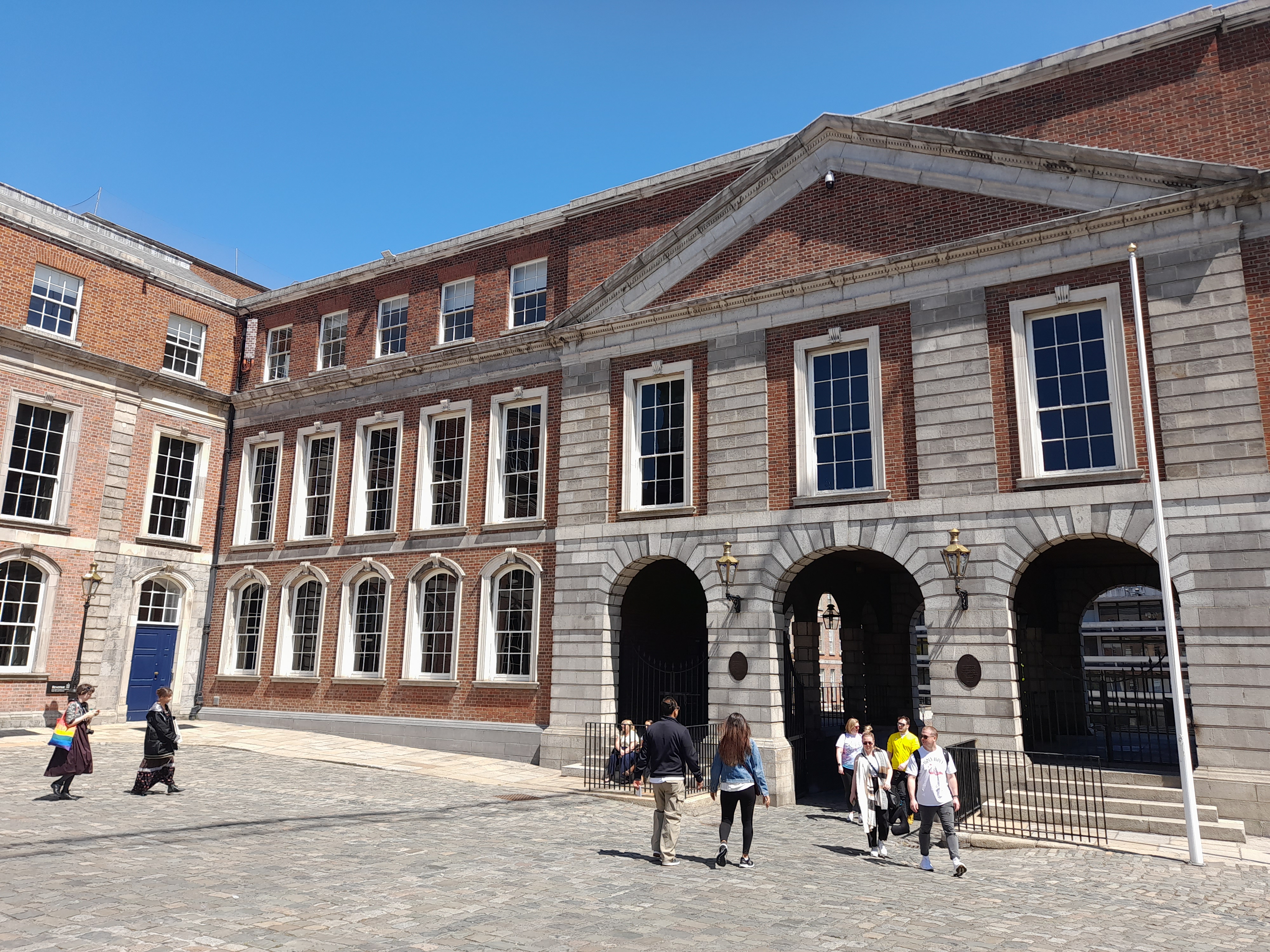
On my walk around Dublin yesterday, as well as seeking locations relevant to my ancestor Teresa Mooney (see https://scottishgenes.blogspot.com/2023/06/researching-my-ancestor-teresa-mooney.html), I decided to prioritise one other place I had never been to before, and that was Dublin Castle. This was the seat of British power in Ireland for centuries, until the point in August 1922 when the British Army symbolicallly handed over control of the nation to the Irish Free State Army (the 'National Army'). I did not have time to do a tour, and so simply visited the place briefly to get a sense of where it was, in anticipation of a future visit. The courtyard is huge, and packed with tourists. You can find more about the castle at https://www.dublincastle.ie

I also had time to briefly pop into the General Post Office on O'Connell Street (which used to be known as Sackville Street), my first time inside in about 20 years, as I'm always in Dublin on Sundays or bank holidays, when it is closed! Another remarkable location, and where the proclamation was read in 1916 during the Easter Rising stating that Ireland was to become a republic (finally achieved in 1949).

Close to the Travelodge Plus hotel where I was staying I came across a wonderful statue of Constance Markiewicz, the first women ever to be elected as a Member of Parliament at Westminster (as a member of Sinn Fein). Markiewicz was also a founding member of Cumann na mBan and the Irish Citizen Army, which fought in the rebellion in 1916.    

Finally, a glimpse of the Parnell monument on O'Connell Street, dedciated to Charles Stewart Parnell, which carries the famous wording that "No Man has a right to fix the boundary to the march of a nation. No man has a right to say to his country "Thus far shalt thou go and no further". We have never attempted to fix the ne-plus-ultra to the progress of Ireland’s nationhood and we never shall".


* For more on the revolutionary period, including how to research members of both the Republican and Crown forces, there is a chapter on the Decade of Centenaries in my book, Tracing Your Irish Family History on the Internet (2nd edition) - see below for details on how to order! 

Chris 

Order Tracing Your Belfast Ancestors in the UK at https://bit.ly/BelfastAncestors. Also available - Tracing Your Irish Ancestors Through Land Records, Sharing Your Family History Online, Tracing Your Scottish Family History on the Internet, Tracing Your Irish Family History on the Internet (2nd ed), and Tracing Your Scottish Ancestry Through Church and State Records - to purchase, please visit https://bit.ly/ChrisPatonPSbooks. For the USA visit https://www.penandswordbooks.com. Further news published daily on The Scottish GENES Facebook page, and on Twitter @genesblog.

A Strong Dublin Woman: Researching my ancestor Teresa Mooney

Whilst in Dublin I wanted to visit two locations that topped and tailed the story of my three times great grandmother, Teresa Mooney, born 1834 and passed away in 1919. Teresa's family to date is the only confirmed Irish Catholic line that I have in my tree, although I do have a couple of lines that I strongly suspect involved mixed denominational marriages, a bit further north in Donegal and Fermanagh.

Teresa was born in the city of Dublin, in 1834 to Thomas and Mary Anne Mooney, and baptised on October 14th 1834 at St. Mary's Roman Catholic Pro-Cathedral (www.procathedral.ie). This was my first stop, to locate the building, and I nearly kicked myself when I found it, as it is about a minute away from O'Connell Street, which I have visited more times than I can remember! Not only was this where Teresa was baptised, it is also where Michael Collins' funeral was held after his assassination in 1922. The 'Pro' in 'Pro-Cathedral' stands for 'Provisional' it being the provisional cathedral built for the city's Roman Catholic community, with two Protestant cathedrals having already been erected (Christ Church and St. Patrick's), and is a gorgeous, peaceful building, right in the heart of the city. 


I don't know much about Teresa's early life, other than that she had a sister called Mary, and may have had a brother called Thomas (I'm working on a DNA connection to try to confirm this), but she later became one of the strongest women in my family. I have no idea how she ended up there, but Teresa married Corporal Alexander William Halliday of the 2nd Battalion of the 2nd Regiment of Foot (Queen's) on June 27th 1862 at the Garrison Church in Corfu, deep in the Mediterranean Sea, with the service being Anglican in nature. She then travelled with Alexander's regiment to Gibraltar, where on October 7th 1863 she gave birth to my great great grandmother Florence Teresa Halliday.

By 1866 the regiment was in Bermuda, where two key events occurred. The first was that Teresa's husband Alexander tragically died on 31st January 1866. Although the death took place in the aftermath of a serious yellow fever epidemic which took many lives from the military unit, there is no indication as to whether Alexander was himself killed by this plague. From muster rolls held at the National Archives in England (www.nationalarchives.gov.uk), I established that Teresa was given £4 17 shillings and 11 pence by the regiment, but after after all of Alexander's outstanding debts were paid off, she was left with just 8 shillings and a ha'penny for her passage home - regulations stipulated that widowed women had to leave the unit of their deceased husband within four weeks after his death.  


However, Teresa somehow remained with the unit, perhaps because of her pregnancy, and shortly after gave birth to a son, Alexander William Halliday, in Bermuda, on August 16th. With two infant children to care for, it is perhaps not surprising that she remarried quickly. The wedding took place on December 28th 1866 in Nenagh, County Tipperary, Ireland, showing that Teresa and the regiment had almost immediately departed Bermuda after Alexander's birth. Her new husband, William John Burns, had also been on Bermuda, and like her former husband Alexander was also a corporal with the 2nd Battalion of the Queen's Royal Regiment. In her second marriage record her father Thomas was noted as a weaver, and the service was again Anglican in nature.

Whilst at Nenagh, her husband William re-attested for another eleven year stint of service with the regiment, but was discharged from the regiment on January 28th 1870 as being unfit for service. Teresa and William then had two children between them. The first was Sarah Jordan Burns, born in Rathmines, Dublin on March 1st 1871, with Teresa noted as being based at Church Lane, and by June 8th 1871, at 14 Wexford Street. By April 11th 1873 they had relocated to Belfast, where their second daughter, Teresa, was born, although within a year young Teresa had died of scarlatina at the Belfast workhouse. In this record her mother was noted as a charwoman.

On August 1st 1878 Teresa's son Alexander was admitted to the Royal Hibernian Military School in Dublin, with his mother noted as 'Trease Burns' and sisters as Florence and Sarah. Alexander later went on to serve in the same regiment as his father. Three years later in 1881, Teresa's eldest daughter Florence married my great great grandfather Edwin Graham in Barrow-on-Furness in England.

In the 1901 census Teresa was noted as being in County Dublin for the 1901 census, by now a 65 year old widow at Woodroffe's Cottages at New Kilmainham, Dublin. She was described as Anglican by way of her religious persuasion, a seamstress who could read and write, and born in Dublin City. It is not yet known when and where her husband William died.

Teresa's son Alexander left the army between 1901 and 1911. In the 1911 census he appears in Dublin at 3 Synnott Row, with his mother, and it was here that I made my second stop. The house is a small cottage in a row not far from the north end of O' Connell Street (known back then as Sackville Street), and whilst there I was fortunate to bump into the current owner as she was returning from some chores. I explained my interest in the property, and was informed that this was still the original building but that last year it had undergone a major renovation, including repointing of the brick work outside, making it seem more modern than it is. 


In the 1911 census, Teresa was still noted as being Anglican, but her son Alexander was listed as Roman Catholic, returning to the religion of his mother before her first marriage. His 39 year old wife Margaret was also in residence. Alexander was noted as a 'motorman', and just two years later he was one of the first tram workers to go on strike, in what led to Ireland's biggest ever industrial dispute, the Dublin Lockout.

In April 1916, just a few streets away from the property, the Easter Rising kicked off, with the proclamation of an Irish republic brutally repressed by the Crown forces, which led just under three years later to a breakaway Irish government being formed in January 1919. What I would give to hear Teresa's testimony of what she may have heard that week! She survived long enough to see the creation of the First Dáil (government), in the middle of the War of Independence, but sadly not the creation of the Irish Free State, she passing away on May 16th 1919 at 3 Synnot Row, aged 83. The cause of death was senile decay and asthma.

Teresa was subsequently buried at the St. Bridget's section of Glasnevin Cemetery, but there is unfortunately no headstone to mark her grave (below). Her son Alexander continued to live at the cottage until his own death in 1947.

Teresa Mooney was a remarkable woman who travelled the world, doing what she had to do to survive with her children, and who ended her days back in Ireland, where she would have witnessed the birth pangs of the new independent state. Her daughter Florence, my great great grandmother, married into a Protestant family in Belfast, and gave birth sixteen times, with eight of her children dying in infancy. 

Another era, another world, but the strength of the women in my family on that line is something I will be forever grateful for.

Chris

Order Tracing Your Belfast Ancestors in the UK at https://bit.ly/BelfastAncestors. Also available - Tracing Your Irish Ancestors Through Land Records, Sharing Your Family History Online, Tracing Your Scottish Family History on the Internet, Tracing Your Irish Family History on the Internet (2nd ed), and Tracing Your Scottish Ancestry Through Church and State Records - to purchase, please visit https://bit.ly/ChrisPatonPSbooks. For the USA visit https://www.penandswordbooks.com. Further news published daily on The Scottish GENES Facebook page, and on Twitter @genesblog.

Sunday, 30 October 2022

Ancestry adds to Royal College of Physicians of Ireland Registers, 1667-1920

A new Irish collection recently added to Ancestry (www.ancestry.co.uk):

Ireland, Royal College of Physicians of Ireland Registers, 1667-1920
https://www.ancestry.co.uk/search/collections/62261/
Source: Original data: Royal College of Physicians Ireland Registers, 1667-1920. Dublin, Ireland: Royal College of Physicians of Ireland

About Ireland, Royal College of Physicians of Ireland Registers, 1667-1920

This collection comprises registers created by the Royal College of Physicians of Ireland between 1667 and 1920. The Royal College of Physicians of Ireland is an educational institution and a professional society dedicated to the improvement of medical care and the licensing of physicians. The registers include names of the society's members and dates related to their licensing and membership. The registers also may include a physician's place of residence and date of death however they don't include information about the member's birth or family.

Using this collection

  • Records in this collection may include the following information:
  • Physician's name
  • Position within the Royal College of Physicians
  • Date the information was recorded
  • Residence
  • Date of death

Further details at https://www.ancestry.co.uk/search/collections/62261/

Chris

My new book Tracing Your Irish Ancestors Through Land Records is now available to buy at https://bit.ly/IrishLandRecords. Also available - Sharing Your Family History Online, Tracing Your Scottish Family History on the Internet, Tracing Your Irish Family History on the Internet (2nd ed), and Tracing Your Scottish Ancestry Through Church and State Records - to purchase, please visit https://bit.ly/ChrisPatonPSbooks. Further news published daily on The Scottish GENES Facebook page, and on Twitter @genesblog.

Friday, 3 June 2022

Access to many RCBL records temporarily suspended

I've just noticed the following on the website of the Representative Church Body Library (https://www.ireland.anglican.org/about/rcb-library) in Dublin, which holds many records for the Church of Ireland:

Important notice: Access to Manuscripts, Diocesan and Cathedral Archives Suspended

For essential maintenance in our strong–rooms we regret to inform researchers that access to all manuscripts, diocesan and cathedral collections in the Library is suspended until further notice.

Parish record collections continue to be available. We will update you as soon as works are complete.

Chris

My new book Tracing Your Irish Ancestors Through Land Records is now available to buy at https://bit.ly/IrishLandRecords. Also available - Sharing Your Family History Online, Tracing Your Scottish Family History on the Internet, Tracing Your Irish Family History on the Internet (2nd ed), and Tracing Your Scottish Ancestry Through Church and State Records - to purchase, please visit https://bit.ly/ChrisPatonPSbooks. Further news published daily on The Scottish GENES Facebook page, and on Twitter @genesblog.

Saturday, 28 May 2022

TheGenealogist adds Dublin city 1851 census names

From TheGenealogist (www.thegenealogist.co.uk):

Search for Dublin Ancestors with the latest release from TheGenealogist

This week TheGenealogist is pleased to be releasing almost 60,000 records from the 1851 Dublin City Census Index. This new release will be a great aid for those researchers with ancestors who may have been living in Ireland’s Capital City on the 30 March 1851 at the time when the census was taken.

Researchers will find the Index to the 1851 Dublin census to be a wonderful tool for anyone searching for people in Dublin city in the mid-nineteenth century. It provides the names and addresses of approximately 59,000 heads of household and was compiled by Dr. D. A. Chart.

You can search over a million early Irish census records from 1821 to 1851. Also the only complete surviving censuses for Ireland that exist, 1901 and 1911 (over 8 Million records) can be searched via TheGenealogist’s unique search tools, allowing you to search for an ancestor using their address or keywords.

Earlier records compiled for 1813 to 1891 were destroyed at the government's request or by the civil war in 1922. This only leaves census substitutes for researchers of nineteenth century Ireland to use in their quest to delve into their family history.

Fortunately for Dublin Dr. D. A. Chart used the census to compile a “1851 Dublin Heads of Household Index” in 1915. At the time this was primarily to assist staff working in the Public Record Office of Ireland (PROI) searching for proof of age for applicants for the old-age pension.

This index survived the fire and is one of the few remaining fragments of census information available for that time.

TheGenealogist also has a number of Irish Trade and Residential Directories that can be useful for those researching their Dublin ancestors, as well as the previously released Dublin Will and Grant Books.

The 1851 Dublin City Census Index in this current release covers the parishes of
St. Andrew's, St. Anne's, St. Audeon's, St. Bridget's, St. Catherine's, St. George's, St. James's, St. John's, St. Luke's, St. Mark's, St. Mary's, St. Michael's, St. Michan's, St. Nicholas Within, St. Nicholas Without, St. Patrick's Deanery, St. Paul's, St. Peter's, St. Thomas's, St. Werburgh's and the civil parish of Grangegorman.

(With thanks to Nick Thorne)

Chris

My new book Tracing Your Irish Ancestors Through Land Records is now available to buy at https://bit.ly/IrishLandRecords. Also available - Sharing Your Family History Online, Tracing Your Scottish Family History on the Internet, Tracing Your Irish Family History on the Internet (2nd ed), and Tracing Your Scottish Ancestry Through Church and State Records - to purchase, please visit https://bit.ly/ChrisPatonPSbooks. Further news published daily on The Scottish GENES Facebook page, and on Twitter @genesblog.

Tuesday, 10 May 2022

Shane Wilson launches 1830 Valuation of Dublin City beta site

One of the most useful research resources for Irish genealogy research is Shane Wilson's site at www.swilson.info, which carries many finding aids and conversion tools. 

Shane has now added a wonderful new resource, the 1830 Valuation of Dublin City, in beta format, which allows you to search for residents by parish and street name. As it is in beta format, there are no finding aids available just yet, but it's a good job, and if you have Dublin ancestors from this period, as I do, you should hopefully have some fun with this!

The beta site is available at swilson.info/dubcval1830.php

(With thanks to Shane @Shanew147 via #AncestryHour)

Chris

My new book Tracing Your Irish Ancestors Through Land Records is now available to buy at https://bit.ly/IrishLandRecords. Also available - Sharing Your Family History Online, Tracing Your Scottish Family History on the Internet, Tracing Your Irish Family History on the Internet (2nd ed), and Tracing Your Scottish Ancestry Through Church and State Records - to purchase, please visit https://bit.ly/ChrisPatonPSbooks. Further news published daily on The Scottish GENES Facebook page, and on Twitter @genesblog.

Friday, 8 April 2022

FindmyPast adds Quaker deaths from 1810-1918

FindmyPast (www.findmypast.co.uk) has added 27,000 Quaker death records from the Friends Historical Library Dublin, many of the records providing detailed obituaries and biographies.

For further details visit https://www.findmypast.co.uk/blog/new/dorset-quakers.

Chris

My new book Tracing Your Irish Ancestors Through Land Records is now available to buy at https://bit.ly/IrishLandRecords. Also available - Sharing Your Family History Online, Tracing Your Scottish Family History on the Internet, Tracing Your Irish Family History on the Internet (2nd ed), and Tracing Your Scottish Ancestry Through Church and State Records - to purchase, please visit https://bit.ly/ChrisPatonPSbooks. Further news published daily on The Scottish GENES Facebook page, and on Twitter @genesblog.

Thursday, 11 March 2021

Ancestry adds seven new National Archives of Ireland collections

Ancestry (www.ancestry.co.uk) has released the following seven Irish collections as sourced from the National Archives of Ireland (www.nationalarchives.ie) in Dublin:

Ireland, Exchequer Court of Equity Bill Books, 1674-1850   
688,470 records
www.ancestry.co.uk/search/collections/62071 

This collection includes records from the Bill Books of Exchequer in Ireland relating to individuals involved in court proceedings between the years 1674-1850. The Exchequer Court of Equity was at the very centre of Ireland's legal system and from the mid-17th century held jurisdiction over financial disputes such as titles of land, debts and wills. Surviving records consist mainly of bill books which detai case participants and proceedings.


Ireland, Court of Chancery Records, 1633-1851   
841,316 records
www.ancestry.co.uk/search/collections/62070

This collection includes records from the Court of Chancery in Ireland relating to individuals involved in court proceedings between the years 1633-1851. As one of the four older 'Superior' courts in Ireland, the Courts of Chancery were at the very centre of Ireland's legal system. Surviving records consist mainly of bill books with some other records including an Index to Pleadings and records of Pleadings themselves.


Ireland, Church of Ireland Search Forms for Baptisms, Marriages and Burials, 1731-1870
13,624 records
www.ancestry.co.uk/search/collections/62061

The Church of Ireland was decreed the State Church in Ireland in 1536 by an Act of the Irish Parliament. After that date, the parishes of the Church of Ireland became an administration focal point for matters of probate and matrimonial jurisdiction.
Historically, each parish in Ireland kept its own records and, since the Church of Ireland was the established church, these parish records were considered state records. In 1876 a law was passed requiring that Church of Ireland parish registers be sent to the Public Record Office (now the National Archives) in Dublin for safekeeping. This law was amended in 1878 to allow parishes with good storage to retain their records, so not all parish records were sent to Dublin. In addition, some ministers made copies of their records before sending the originals away. Therefore, many Church of Ireland records remain, even though the registers sent to Dublin were lost in 1922 in the fire at the Public Record Office. However, prior to this date, there are surviving records of requests for searches carried out within the records and these are included in this collection.
Church of Ireland parish registers list christenings, marriages, and burials. The amount of information recorded varies from parish to parish and from minister to minister.


Ireland, Catholic Qualification and Convert Rolls, 1701-1845
32,134 records
www.ancestry.co.uk/search/collections/62057

This collection is made up of both qualification and convert rolls. Convert rolls, as the name suggests, details the names of individuals who renounced the Catholic church in favour of the official state church, the Church of Ireland. Converting in this period was the only way to fully escape the sentences and penalties handed out to Catholics and other non-conformists. The Qualification rolls include names of those who took an oath of allegiance to the King. Taking this oath 'qualified' the person to recover some (but not all) rights denied to non-members of the established church. However, those taking the Oath were not required to convert.


Ireland, Poor Law and Board of Guardian Records, 1839-1920   
1,738,323 records
www.ancestry.co.uk/search/collections/62013

The Irish Poor Law Act of 1838 followed very closely the English Poor Law Act of 1834 and divided the country up into Poor Law Unions, centred on a workhouse, which became the main vehicle of assistance to the poor. Each Union elected a Board of Guardians, which was then responsible for care of the poor across all of the individual parishes.

Many people who had fallen on hard times or were born into poverty received help through these Poor Laws, including the elderly, orphaned, abandoned, unemployed, and sick. Aid came as more than just money; the poor could also be provided food, clothing, and work. Children from poor families might be placed in apprenticeships or sent to schools and other institutions. Conditions in workhouses were often extremely hard meaning sickness and, sadly death, was common amongst those who were admitted.
This collection includes workhouse records relating to the North Dublin Union, South Dublin Union, and Rathdown Union (part of counties Dublin and Wicklow). It also includes records relating to Balrothery Union (part of county Dublin), Bawnboy Union (part of county Cavan), and Dromore West Union.


Ireland, Census Search Forms, 1841-1851
127,288 records
www.ancestry.co.uk/search/collections/62026

This collection includes records of census search forms for Ireland for the years 1841 and 1851. In 1908, the Old Age Pensions Act was introduced in Ireland for those aged 70 and over. Proof of age was essential in receiving the pension and, since civil registration was not introduced in Ireland until 1864, applicants did not have their own documentation to use as proof. As a result, they sent off forms to the Public Record Office which held the 1841 and 1851 census records with names and dates for them to confirm so that they could be entitled to the pension. These surviving census search forms are even more valuable given the 1922 fire at the Public Record Office and destruction of the majority of those census records.


Ireland, Valuation Records, 1824-1856   
1,740,993 records
www.ancestry.co.uk/search/collections/62024

This collection comprises records from books relating to the Griffith's Valuation of property in Ireland which took place between 1848 and 1864. These books, including General Notes, Field Books, House Books, Tenure Books and Quarto books contain the information underpinning the conclusions drawn up by Griffith's Valuation or the Primary Valuation. They are an extremely important resource, with comprehensive detailed and descriptive notes on land and property across Ireland in the mid-19th century.  

Chris

Just out, Sharing Your Family History Online is on sale at https://bit.ly/SharingFamHist. Tracing Your Scottish Family History on the Internet, at http://bit.ly/ChrisPaton-Scottish2 is also out, as are Tracing Your Irish Family History on the Internet (2nd ed) at http://bit.ly/ChrisPaton-Irish1 and Tracing Your Scottish Ancestry Through Church and State Records at http://bit.ly/ChrisPaton-Scotland1. Further news published daily on The Scottish GENES Facebook page, and on Twitter @genesblog.
Friday, 15 January 2021

Derry and Dublin cemetery records added to FindmyPast

The following irish cemetery records have been added to FindmyPast (www.findmypast.co.uk):

Ireland, Londonderry (Derry) City Cemetery Burials 1853-1961
70,000 Londonderry (Derry) burial records from the City Cemetery.

Ireland, Dublin City Cemetery Burials 1805-2006
This new collection covers three Dublin cemeteries:

    St John The Baptist, Castle Avenue, Clontarf, Dublin
    Drimnagh (Bluebell), Old Naas Road, Dublin
    St Canice’s, Finglas, Dublin

For links, and info on other records releases, including Dorset (England) burials and newspapers, visit www.findmypast.co.uk/blog/new/irish-burial-records

Chris

Pre-order my next book, Sharing Your Family History Online, at https://bit.ly/SharingFamHist. My book Tracing Your Scottish Family History on the Internet, at http://bit.ly/ChrisPaton-Scottish2 is also out, as are Tracing Your Irish Family History on the Internet (2nd ed) at http://bit.ly/ChrisPaton-Irish1 and Tracing Your Scottish Ancestry Through Church and State Records at http://bit.ly/ChrisPaton-Scotland1. Further news published daily on The Scottish GENES Facebook page, and on Twitter @genesblog.

Friday, 4 December 2020

TheGenealogist releases University, College and School Registers

From TheGenealogist (www.thegenealogist.co.uk):

University, College and School Registers released online by TheGenealogist

TheGenealogist releases more College and University registers into its expanding Educational Records adding a quarter of a million additional individuals. This release includes records from England, Scotland, Ireland, The Netherlands, New Zealand and even a college from Portugal.

The records can be used to discover a student’s achievements and are fantastic for identifying where next to apply your research for an ancestor. Educational records will confirm birth dates and sometimes the place of birth. Usually they give a father’s name and address, which is useful when the parent is missing from the census, and they can give details of the student’s occupation and a great deal more useful information.

Researchers can use this new data to find ancestors who attended or taught at a variety of Educational establishments in a wide range of years up to the mid 1930s. The earliest record in this release is dated 1566 in the Christ's Hospital Exhibitioners to the Universities of Oxford and Cambridge, 1566-1923. In contrast the latest record is 1936, taken from the List of Occupants of Rooms in St John's College 1895-1936.

These records can also be used to identify those who held high office in the institutions, so that University patrons, deans, visitors, professors and masters and the principals and governors of schools are usually included.

Also in this release we have some fascinating Irish Examination Board records from 1889, 1891 and 1892. These reveal the candidates’ names, addresses and grades in all their subjects, including some rather unusual ones. If you can find an ancestor, within these records, it will certainly be an eyeopener as they disclose what subjects your forebear had been a good or a bad student of.

The registers released on TheGenealogist today are:

Aberdeen
Aberdeen Education Authority Members' Directory, 1920-1921
Aberdeen University Roll of Graduates, 1860-1900

Cambridgeshire
Christ's Hospital Exhibitioners to the Universities of Oxford and Cambridge, 1566-1923
List of Occupants of Rooms in St John's College, 1895-1936
Gonville and Caius College Vol. II, 1713-1897
Register of Admissions to King’s College, 1850-1900
Admissions to Peterhouse or S. Peter's College in the University of Cambridge, 1615-1911
Girton College Register, 1869-1946

Devon
Kelly College Register, 1877-1927

Dublin
Alumni Dublineneses, 1593-1846

Edinburgh
University of Edinburgh Graduates, 1859-88
The Fettes College Register, 1870-1932

Dublin
Intermediate Education Board for Ireland, Exhibition and Prize Lists, 1889
Intermediate Education Board for Ireland, Exhibition and Prize Lists, 1890
Intermediate Education Board for Ireland, Examinations Held in 1889 Pass Lists, Boys
Intermediate Education Board for Ireland, Examinations Held in 1892 Pass Lists, Boys
Intermediate Education Board for Ireland, Examinations Held in 1891 Pass Lists, Boys

London
Dulwich College War Record, 1939-1945

Netherlands
University of Leyden, List of English speaking Students of Medicine, 1932

New Zealand
The Early History of Wellington College, N.Z, 1867-1883
New Zealand University Calendar, 1925

Oxfordshire
Alumni Oxonienses (Members of the University of Oxford) 1715-1886 Vol I
Alumni Oxonienses 1715-1886 Vol II
Alumni Oxonienses 1715-1886 Vol III
Alumni Oxonienses 1715-1886 Vol IV
Alumni Oxonienses 1715-1886 Vol V
Alumni Oxonienses 1715-1886 Vol VI
Alumni Oxonienses 1715-1886 Vol VII
Alumni Oxonienses 1715-1886 Vol VIII
Oxford Men and their Colleges, 1880-1892
War Record of the University Press, Oxford, 1914-1919

Portugal
Historical Account of Lisbon College

Surrey
County of Surrey Endowed Institutions Volume IV

Yorkshire
Teachers and Officers of Ackworth School, 1779-1894

Read TheGenealogist’s article on researching more about an ancestor from the leads revealed in the pages of Educational Records:
www.thegenealogist.co.uk/featuredarticles/2020/educational-records-may-reveal-your-ancestors-unusual-achievements-1362/

Chris

Pre-order my next book, Sharing Your Family History Online, at https://bit.ly/SharingFamHist. My book Tracing Your Scottish Family History on the Internet, at http://bit.ly/ChrisPaton-Scottish2 is also out, as are Tracing Your Irish Family History on the Internet (2nd ed) at http://bit.ly/ChrisPaton-Irish1 and Tracing Your Scottish Ancestry Through Church and State Records at http://bit.ly/ChrisPaton-Scotland1. Further news published daily on The Scottish GENES Facebook page, and on Twitter @genesblog.

Friday, 14 August 2020

Edinburgh, Belfast, Dublin and London Gazettes join FindmyPast

FindmyPast (www.findmypast.co.uk) has added some major new newspaper sets to its site this week - although to access them you will need a Pro subscription:

London Gazette 1665-2018
Taken from the official UK government newspaper, unlock over 350 years of fascinating London stories in almost 34 million new records.

Scotland, Edinburgh Gazette 1797-2018
The Edinburgh Gazette is the Official Newspaper of Record for Scotland. In it, you can explore over 220 years of Scottish history and over 4 million individual records.

Ireland, Belfast Gazette 1922-2018
Delve into a nearly century of Northern Irish newspaper stories including business notices and the Queen’s annual honours lists in the Belfast Gazette.

Ireland, Dublin Gazette 1750-1800
Step back into 18th-century Ireland with records covering 50 years of news from the British government at Dublin Castle.

Together, these four Gazette collections bring a staggering 39 million new records to Findmypast this week.

Further details and links are available at https://www.findmypast.co.uk/blog/new/gazettes

Comment: going by the year range, the Dublin Gazette collection looks like that held by the Oireachtas library in Dublin, which I first blogged about being available online in 2015 (see http://britishgenes.blogspot.com/2015/08/the-dublin-gazette-from-1750-1800-is.html). The other Gazette editions are available also freely at www.thegazette.co.uk, but the search screen on FindmyPast looks to be a much less pain free experience! Without a Pro subscription, a basic search will still provide a date for a hit, so you can then consult the original at the Gazette website. The Dublin Gazette is a bit more of a pain, as you need to download the file from the Oireachtas library website, and they tend to be fairly large, although they are keyword searchable.


Don't forget that Iris Oifigiuil, the Dublin Gazette's replacement in the Repubic of Ireland after partition, is available online at www.irisoifigiuil.ie for issues from 2002-2020.

NB: Incidentally, a quick note of thanks to Gerry Quinn (@GerryQuinn10), who has pointed out an error on the FindmyPast Scottish Catholic records - the Sacred Heart Church in Bridgeton, Glasgow, is listed under Dunbartonshire when it should be Lanarkshire - hopefully FMP can amend soon.

Chris

My next 5 week Scottish Research Online course starts August 31st - see https://www.pharostutors.com/details.php?coursenumber=102. My book Tracing Your Scottish Family History on the Internet, at http://bit.ly/ChrisPaton-Scottish2 is now out, also available are Tracing Your Irish Family History on the Internet (2nd ed) at http://bit.ly/ChrisPaton-Irish1 and Tracing Your Scottish Ancestry Through Church and State Records at http://bit.ly/ChrisPaton-Scotland1. Further news published daily on The Scottish GENES Facebook page, and on Twitter @genesblog.

Thursday, 25 June 2020

National Archives of Ireland to reopen on Monday 29th June

The National Archives of Ireland (www.nationalarchives.ie) has made the following announcement on its website:

The National Archives will re-open to the public on a limited, appointment-only basis from Monday June 29th.

Please check back to this website later in the week to book your appointment online.


Chris

My next 5 week Scotland 1750-1850: Beyond the Old Parish Registers course starts July 6th - see https://www.pharostutors.com/details.php?coursenumber=302. My next book, Tracing Your Scottish Family History on the Internet, at http://bit.ly/ChrisPaton-Scottish2 is now out, also available are Tracing Your Irish Family History on the Internet (2nd ed) at http://bit.ly/ChrisPaton-Irish1 and Tracing Your Scottish Ancestry Through Church and State Records at http://bit.ly/ChrisPaton-Scotland1. Further news published daily on The Scottish GENES Facebook page, and on Twitter @genesblog.

Wednesday, 15 April 2020

RootsIreland adds North Dublin dog license holder records

From RootsIreland (www.rootsireland.ie):

New North Dublin Records

We are delighted to announce that 639 dog licence holders in North Dublin have been added to our database at www.rootsireland.ie/dublinnorth under 'Census Substitutes'. It includes the names and addresses of residents in the greater Swords area in the period 1923-24. It covers Swords, Malahide, Donabate and parts of rural Fingal and gives an insight into various townland names.

To search these records, go to dublinnorth.rootsireland.ie, choose 'Census Substitutes' and select 'Dog Licenses' from the 'Source' drop down list. Please Login and Subscribe if required.


Chris

You can pre-order my new book, Tracing Your Scottish Family History on the Internet, at http://bit.ly/ChrisPaton-Scottish2 (out April). Also available, Tracing Your Irish Family History on the Internet (2nd ed) at http://bit.ly/ChrisPaton-Irish1 and Tracing Your Scottish Ancestry Through Church and State Records at http://bit.ly/ChrisPaton-Scotland1. Further news published daily on The Scottish GENES Facebook page, and on Twitter @genesblog.