Showing posts with label POWs. Show all posts

Monday, 19 May 2025

Recent notable additions to Ancestry


The following are some of the more noticeable collections aded to Ancestry (www.ancestry.co.uk) over the last couple of months that may be of interest:

UK, Recommendations for Honours and Awards, 1935-1943
https://www.ancestry.co.uk/search/collections/63097/ (full collection on Fold3.com)

UK, Postal Establishment Books, 1691-1979
https://www.ancestry.co.uk/search/collections/62454/

UK, Navy Board and Predecessors Prisoner of War Registers, 1755-1831
https://www.ancestry.co.uk/search/collections/63094/ (full collection on Fold3.com)

Web: Caribbean, Aircrew in the RAF during World War II, 1939-1945
https://www.ancestry.co.uk/search/collections/63333/

Chris

Order Tracing Your Belfast Ancestors in the UK at https://bit.ly/BelfastAncestors. Also available - Tracing Your Irish Ancestors Through Land Records, Sharing Your Family History Online, Tracing Your Scottish Family History on the Internet, Tracing Your Irish Family History on the Internet (2nd ed), and Tracing Your Scottish Ancestry Through Church and State Records - to purchase, please visit https://bit.ly/ChrisPatonPSbooks. For purchase in tthe USA visit https://www.penandswordbooks.com. Further news published daily on The Scottish GENES Facebook page, on Threads at @scottishgenesblog and via Mastodon at https://mastodon.scot/@ScottishGENES.

Wednesday, 2 August 2023

Ancestry adds WW2 liberated Prisoners of War questionnaires

Added by Ancestry (www.ancestry.co.uk):

UK and Allied Countries, World War II Liberated Prisoner of War Questionnaires, 1945-1946
https://www.ancestry.co.uk/search/collections/62114/
Source: WO 344: War Office: Directorate of Military Intelligence: Liberated Prisoner of War Interrogation Questionnaires, 1945-1946. Kew, Surrey, England: The National Archives.

About UK and Allied Countries, World War II Liberated Prisoner of War Questionnaires, 1945-1946

General collection information

This collection comprises questionnaires filled out by prisoners of war who were liberated at the end of the Second World War in 1945. The questionnaires were given to thousands of British and Commonwealth soldiers captured by Germany, Italy, or Japan. The questionnaires provide information about various dates related to each soldier's military service and time as a prisoner of war. Some records may only have dates while others can provide rich details about the treatment of prisoners of war, attempts to escape, and the conditions in the camps in which they were held.

Using this collection

Records in this collection may include the following information:

  • Name
  • Rank
  • Service number
  • Ship name
  • Unit name
  • Birth date
  • Enlistment date
  • Capture date and place
  • Escape attempt details


The information in the questionnaires can be used to verify that enemy forces captured your ancestor at a specific place and time during the Second World War. You also may discover if your ancestor had any serious illnesses during captivity or if they witnessed any courageous acts by fellow prisoners of war. If your family member attempted to escape, you may find out about their evasive activities and any people who helped them during the attempt.

Further information can be found via the link above.

Chris

Order Tracing Your Belfast Ancestors in the UK at https://bit.ly/BelfastAncestors. Also available - Tracing Your Irish Ancestors Through Land Records, Sharing Your Family History Online, Tracing Your Scottish Family History on the Internet, Tracing Your Irish Family History on the Internet (2nd ed), and Tracing Your Scottish Ancestry Through Church and State Records - to purchase, please visit https://bit.ly/ChrisPatonPSbooks. For purchase in tthe USA visit https://www.penandswordbooks.com. Further news published daily on The Scottish GENES Facebook page, on Threads at @scottishgenesblog and via Mastodon at https://mastodon.scot/@ScottishGENES.

Wednesday, 25 May 2022

FamilySearch adds UK Prisoners of War 1715-1947 collection

FamilySearch (www.familysearch.org) has added the following collections:

Prisoners of War, 1715-1947
https://www.familysearch.org/search/collection/4459223

Comprised of various records held by The National Archives (England) detailing refugees and individuals taken as prisoners of war during major conflicts around the globe. The records contain the names of military personnel, civilians, diplomats, missionaries, and merchant seamen from nations all over the world.

Images are only available to FamilySearch members, their family history centres, their affilates, or at the National Archives in England (which holds the originals).

From the FamilySearch wiki entry at https://www.familysearch.org/en/wiki/Prisoners_of_War_-_FamilySearch_Historical_Records

Conflicts include:

  • Napoleonic Wars, 1747-1889
  • Crimean and Boer Wars, 1795-1951
  • World War I, 1913-1918

Sources:

  • ADM 1, Admiralty, and Ministry of Defence, Navy Department: Correspondence and Papers
  • AIR 1, Air Ministry: Air Historical Branch: Papers (Series I)
  • BT 167 Registry of Shipping and Seamen: Precedent Books, Establishment Papers, etc.
  • CAB 45, Committee of Imperial Defence, Historical Branch and Cabinet Office, Historical Section: Official War Histories Correspondence and Papers
  • CO 693, Colonial Office: Dominions (War of 1914-1918), Prisoners Original Correspondence
  • FO 372, Foreign Office: Treaty Department and successors: General Correspondence from 1906
  • FO 383, Foreign Office: Prisoners of War and Aliens Department: General Correspondence from 1906
  • MT 9, Board of Trade and Ministry of Transport and successors: Marine, Harbours and Wrecks (M, H and W Series) Files
  • WO 161, War Office: Miscellaneous Unregistered Papers, First World War
  • WO 900, War Office: Specimens of Series of Documents Destroyed


Comment: Unfortunately, this is not an easy collection to use, as FamilySearch's default search fields are largely incompatible with the data fields presented in the returns. It looks like you can only search by name and date - and in most cases that I have seen so far, it seems to be the initial returned for a first name only.

Chris

My new book Tracing Your Irish Ancestors Through Land Records is now available to buy at https://bit.ly/IrishLandRecords. Also available - Sharing Your Family History Online, Tracing Your Scottish Family History on the Internet, Tracing Your Irish Family History on the Internet (2nd ed), and Tracing Your Scottish Ancestry Through Church and State Records - to purchase, please visit https://bit.ly/ChrisPatonPSbooks. Further news published daily on The Scottish GENES Facebook page, and on Twitter @genesblog.

Saturday, 24 October 2020

Connecting emotionally with past events

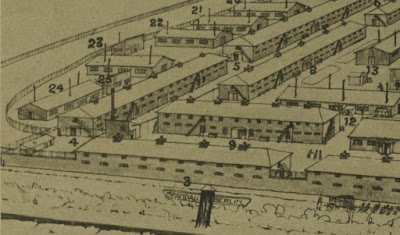
I was updating a talk last night for the forthcoming Family History Foundation's Really Useful Virtual Family History Show (www.fhf-reallyuseful.com) on November 14th, in which I will be speaking on the topic of British Civilian POWs in the First World War. This will essentially focus on the story of the Ruhleben camp (pictured below), near Berlin, at which 5500 British civilians, and civilians from the British Empire, were interned for simply being in the wrong place at the wrong time when war was declared.

I have a personal connection to the story, in that my Scottish great grandfather, David Hepburn Paton, a Scottish shop manager in Brussels, Belgium, at the outbreak of the war, was forced into hiding to avoid being arrested following the internment order issued by the German government in November 1914. David died in 1916 during his concealment, leaving his wife, Jessie MacFarlane, and three children to live in Brussels with little to no financial support during the remainder of the occupation. In the aftermath of his death, his son John (pictured below) was subsequently arrested and sent to Ruhleben, where he remained for the rest of the war.

I knew about John's time at Ruhleben, and that he had been arrested because he had turned 'of age'. John had been born on 29 October 1898 in Brussels, and a document from the National Archives at Kew had shown that he was taken to Ruhleben on December 1st 1916. No matter how many times I have gone through the documents, however, I discovered something last night that had been staring me in the face for a couple of years that had not initially clicked into place, but which unusually provoked a brief emotional response from me last night of sheer bloody anger.

A couple of years back I obtained a copy of another record concerning John on the Prisoners of the First World War website at https://grandeguerre.icrc.org, an online platform of the International Committee of the Red Cross. There was not a lot of detail on the form, but one I had either weirdly overlooked, or simply hadn't added to another 2 to make 4, was that it listed his date of arrest in Brussels, given as October 31st 1916. Whilst inserting this into the chronology of other records detailing his story last night, I have only just twigged, or perhaps only just remembered, that he was in fact arrested just two days after he had turned 18 years of age.

As family historians, we try to avoid judging events in the past, because we only work in the past and do not live within it, and no matter how hard we try we can never truly understand the contemporary context of happened with any event - we can only pick up the documented pieces afterwards and try to at least gain a glimpse of proceedings. Sometimes phrases may have more meaning in those documents than we at first may determine. In a letter from 1917, an uncle of John's noted that "when of age he was taken away", which I initially just assumed meant that John was at Ruhleben because he was aged 18, but in hindsight, I am now thinking he literally meant that he was recalling the exact experience of how he was taken away when he turned 18, which must have been a traumatic moment in time for the whole family.

But it wasn't as a family historian that I became angry last night, it was as a parent. Right now I have two sons, about to turn 16 and 20, so John was halfway between their two ages at the time he was lifted. Having just become what the authorities recognised as a man in a legal sense, he was taken, perhaps dragged, from his mother and siblings, for the crime of simply turning 18, and transported from his home in Brussels to another country, where another language was spoken by the authorities, to spend a month at the Berlin based Stadtvogtei prison, before being taken to Ruhleben. 

What must have been going through his mind? What must his recently widowed mother been going through in Belgium, and my grandfather (aged just 12 at the time), and their sister? 

And what if this had happened to one of my boys? 

I have no photograph of my great grandmother Jessie, I have just one letter written by her from Brussels during the occupation in which she noted that my grandfather, as a young boy, was "ill from privation", she barely having the means to survive financially. I have a few facts about her life afterwards back in Scotland following the war, in Glasgow and Inverness, but beyond that, she remains mainly a technical construct, the product of a few documents, giving me a glimpse into who she might have been in a factual sense. But last night, I got another glimpse of her, a brief emotional insight into what she must have experienced. In perhaps just a minor way, and for a short moment, it elevated my understanding of her beyond anything a single document could reveal. 

Last night, Jessie Paton nee MacFarlane (1866-1948) wasn't just my great grandmother, she was my grandad's mum, a parent who like many of us will have had to overcome adversity to enable a future for her kids. Thanks Jessie.

For more on my talk, British Civilian POWs in World War One, and for details of other talks and speakers at the FHF event on November 14th, visit www.fhf-reallyuseful.com/speakers/. We'll hopefully see you there!

Chris

My next 5 week Scotland 1750-1850: Beyond the Old Parish Registers course starts November 2nd - see https://www.pharostutors.com/details.php?coursenumber=302. My book Tracing Your Scottish Family History on the Internet, at http://bit.ly/ChrisPaton-Scottish2 is now out, also available are Tracing Your Irish Family History on the Internet (2nd ed) at http://bit.ly/ChrisPaton-Irish1 and Tracing Your Scottish Ancestry Through Church and State Records at http://bit.ly/ChrisPaton-Scotland1. Further news published daily on The Scottish GENES Facebook page, and on Twitter @genesblog.

Sunday, 2 February 2020

Book review: The Ruhleben Football Association by Paul Brown

A huge thanks to Paul Brown for a review copy of his new book, The Ruhleben Football Association: How Steve Bloomer's Footballers Survived a World War Prison Camp.

The following is the listed description of the book:

In 1914, at the outbreak of the First World War, several of Britain's greatest footballers were interned in a brutal German prison camp at Ruhleben, near Berlin. Among them was Steve Bloomer, the prolific England striker widely regarded as the best player of his generation. Surrounded by barbed wire and armed guards, living in squalor and on meagre rations, and with their families and freedom far out of reach, Bloomer and the others found salvation in what they knew best – football.

They bartered for balls, marked out pitches, and formed the Ruhleben Football Association, organising league and cup competitions involving hundreds of players and watched by thousands of spectators.

The conditions at Ruhleben – a former horse racing track – were appalling, with around 4,500 men packed into 11 filthy stables. Food was scarce, the guards were cruel, and the commandant was incompetent. Gradually, though, as the Great War for Civilisation raged around them, Bloomer and his fellow prisoners established some order within the confines of the prison camp.

This is the true story of how the prisoners used the game of football to survive, and how some of them used it to escape.

Prominent footballers in Ruhleben prison camp:
Steve Bloomer: England, Derby County, Middlesbrough
Fred Pentland: England, Blackburn Rovers, Middlesbrough, QPR, Brentford, Stoke, Blackpool, Halifax Town, Small Heath (Birmingham City)
John "Jack" Cameron: Scotland, Queen’s Park, Everton, Tottenham Hotspur
Sam Wolstenholme: England, Everton, Blackburn, Norwich City
John "Jack" Brearley: Tottenham, Everton, Crystal Palace, Millwall, Notts County
Edwin Dutton: Germany, Newcastle United
Percy Hartley: Preston North End, Huddersfield Town, Exeter City
Walter "Wattie" Campbell: Everton

The book contains more than 30 photographs and illustrations.


Ruhleben, the WW1 British civilian based POW camp located just outside Berlin, is a subject I have long been fascinated by, with my great uncle John Paton interned there as a young lad from 1916-1918, and being the inspiration for my own The Ruhleben Story project (http://ruhleben.tripod.com). It was a place filled with so many extraordinary folk, and Paul's book takes a superb look at the story of one particular group of inmates, the professional footballers interned at the start of the war for being in the wrong place at the wrong time, including English international Steve Bloomer.

The book is structured across twelve chapters, with an additional prologue and epilogue, followed by brief biographical accounts of the professional footballers, as well as various source acknowledgements. Paul starts with Bloomer's story, before reaching the extraordinary camp in Chapter 3. He then describes the camp, its organisation and administration,before introducing other players such as Fred Pentland (England and Middlesborough) and John Cameron (Scotland), who found themselves there for similar reasons.

As POWs, the inmates had to find interests to occupy themselves, and in the case of the footballers, it was the establishment of the Ruhleben Football Association. Paul expertly describes its creation and structure, the league seasons played in the camp between prisoners of different barracks, as well as the international on May 2nd 1915 between the "England XI" and "World XI" sides.

The book is a superb account of the tribulations endured, and is well illustrated with many photos I've not seen before. Thoroughly recommended!

The Ruhleben Football Association: How Steve Bloomer's Footballers Survived a World War Prison Camp is published by Goal Post books (www.goalpostbooks.co.uk), and is priced at UK£10.

(With thanks to Paul Brown)

Chris

You can pre-order my new book, Tracing Your Scottish Family History on the Internet, at http://bit.ly/ChrisPaton-Scottish2 (out April). Also available, Tracing Your Irish Family History on the Internet (2nd ed) at http://bit.ly/ChrisPaton-Irish1 and Tracing Your Scottish Ancestry Through Church and State Records at http://bit.ly/ChrisPaton-Scotland1. Further news published daily on The Scottish GENES Facebook page, and on Twitter @genesblog.

Transcription Tuesday: Stobs Military Camp WW1 project

One of the projects selected for this year's Transcription Tuesday event is a Scottish based effort to try to find the names of those interned at Stobs Military Camp during the First World War.

Hannah Bell has shared the following about the project with Who Do You Think You Are? magazine at http://www.whodoyouthinkyouaremagazine.com/news/transcription-tuesday-2020-stobs-camp-prisoner-records. In her account she describes the projhect as follows:

When the First World War broke out in 1914, German and Austrian civilians living in Britain were seen as ‘the enemy within’.

Many were interned in detention camps, either because they were considered a threat to national security or to protect them from hostile citizens.

Foreign nationals were interned at Stobs from the start of the war.

Over the next four years, they were joined by captured soldiers and sailors, and eventually it became a prisoner of war camp.

Records from 1916 list 4,616 prisoners, of whom 1,829 were soldiers, 504 sailors and 2,283 civilians.

Of the civilians, 2,098 were Germans, 181 Austrians, 3 Turks and 1 Bulgarian.

After years of research, we have finally been presented with the opportunity of learning the names of the German prisoners at Stobs both civilian and military.


I am very much looking forward to seeing the results of this project; my own project The Ruhleben Story (http://ruhleben.tripod.com), is something of a mirror image of it, in tracing civilian Scottish, British and former British Empire based citizens in a German POW camp, erected for similar reasons.

For further information on how to take part in the transcription effort on Tuesday 4th February, please visit http://www.whodoyouthinkyouaremagazine.com/blog/transcription-tuesday-2020-stobs-camp-project. For more on the Stobs Military Camp visit http://www.stobscamp.org.


There will be three other projects available on Transcription Tuesday also:

FamilySearch: Parish Registers
Discover the lives of people who were baptised, married and buried outside the Church of England by transcribing nonconformist records from Essex, Gloucestershire, Lancashire, Northumberland and Norfolk.

Ancestry: West Midlands Police Records
Transcribe detailed records of police officers who served across the West Midlands from the 1860s to the 1940s for Ancestry's free World Archives Project.

Royal Navy First World War Lives at Sea
Help create a database of First World War Royal Navy records with this partnership between The National Archives and the National Maritime Museum.

For further details visit http://www.whodoyouthinkyouaremagazine.com/transcriptiontuesday

Chris

You can pre-order my new book, Tracing Your Scottish Family History on the Internet, at http://bit.ly/ChrisPaton-Scottish2 (out April). Also available, Tracing Your Irish Family History on the Internet (2nd ed) at http://bit.ly/ChrisPaton-Irish1 and Tracing Your Scottish Ancestry Through Church and State Records at http://bit.ly/ChrisPaton-Scotland1. Further news published daily on The Scottish GENES Facebook page, and on Twitter @genesblog.