Showing posts with label Hallowe'en. Show all posts

Tuesday, 29 October 2024

Free access to MyHeritage's death records collections for Hallowe'en

From October 29th to November 1st 2024, MyHeritage (www.myheritage.com) is offering free access to its death, burial, cemetery, and obituary records. There are nearly 1.2 billion records in 435 collections.

For more on the story visit https://blog.myheritage.com/2024/10/discover-your-ancestors-stories-with-free-access-to-death-records-this-halloween.

(With thanks to Daniel Horowitz)

Chris

Order Tracing Your Belfast Ancestors in the UK at https://bit.ly/BelfastAncestors. Also available - Tracing Your Irish Ancestors Through Land Records, Sharing Your Family History Online, Tracing Your Scottish Family History on the Internet, Tracing Your Irish Family History on the Internet (2nd ed), and Tracing Your Scottish Ancestry Through Church and State Records - to purchase, please visit https://bit.ly/ChrisPatonPSbooks. For purchase in the USA visit https://www.penandswordbooks.com. Further news published daily on The Scottish GENES Facebook page, on Threads at @scottishgenesblog and via Mastodon at https://mastodon.scot/@ScottishGENES.

Friday, 27 October 2023

Scottish witchcraft cases resources

Some online resources to research Scottish witchcraft cases: 

FindmyPast (www.findmypast.co.uk) added the following collectiona couple of years back:

Scotland, Names of Witches 1658
In this small but spooky collection, you’ll find details on some of those accused of witchcraft in early modern Scotland. 1563’s Witchcraft Act made consorting with witches or taking part in witchcraft a crime punishable by death in Scotland. Around 1,500 people were executed, most of them women, until the last Scottish witch trial in 1727.
(Source: Wellcome Collection, Names of the Witches (in Scotland), 1658, MS.3658)

In 2016 Ancestry (www.ancestry.co.uk) previously released the same collection:

Scotland, Names of Witches, 1658
http://search.ancestry.co.uk/search/db.aspx?dbid=61099
Source: Names of Witches in Scotland. Wellcome Library, London, England.

About Scotland, Names of Witches, 1658

The passing of the Scottish Witchcraft Act in 1563 made witchcraft, or consulting with witches, capital crimes in Scotland. It is estimated that between three and five thousand women were publicly accused of being witches in 16th and 17th century Scotland, a much higher number than neighbouring England. Some men were also accused of witchcraft during this period, however, the number of women persecuted was far larger.

The outbreak of witch-hunting in the years 1658-1662, the period in which this list of names was created, is generally agreed to represent the high water mark of Scottish persecution.

Within this collection, you will be able to find details of the accused's name and resident town.

(Image: Wellcome Library)

There was a bit more on the book's release on Scottish Legal news at https://web.archive.org/web/20161028130410/http://www.scottishlegal.com/2016/10/27/book-listing-those-accused-of-witchcraft-in-17th-century-scotland-digitised/

Don't forget the University of Edinburgh's Survey of Scottish Witchcraft website at http://witches.shca.ed.ac.uk. There is more about this project at https://en.wikipedia.org/wiki/Survey_of_Scottish_Witchcraft

Chris

Order Tracing Your Belfast Ancestors in the UK at https://bit.ly/BelfastAncestors. Also available - Tracing Your Irish Ancestors Through Land Records, Sharing Your Family History Online, Tracing Your Scottish Family History on the Internet, Tracing Your Irish Family History on the Internet (2nd ed), and Tracing Your Scottish Ancestry Through Church and State Records - to purchase, please visit https://bit.ly/ChrisPatonPSbooks. For purchase in tthe USA visit https://www.penandswordbooks.com. Further news published daily on The Scottish GENES Facebook page, on Threads at @scottishgenesblog and via Mastodon at https://mastodon.scot/@ScottishGENES.

Ghostbusting in Inveraray

In late 2009 I was invited to go on a ghosthunting event at Inveraray Jail in Argyll by a tour operator. I wrote up my escapades for two magazines, a short piece for Scottish Memories, and a longer piece for Discover my Past Scotland. As we get closer to Hallowe'en, here's the article from DMPS (with a couple of links updated) - enjoy!

Ghostbusting in Inveraray

Chris Paton goes in search of the paranormal at a 19th century jail…

A few years ago a discussion was aired in British genealogical magazines about whether the use of mediums was a valid tool for family history research. Personally speaking, I don’t believe in ghosts at all and am a complete sceptic, so have never paid attention to any of this in a professional capacity.

I should add, though, that this actually flies in the face of family tradition! In my mother’s paternal ancestry, the Grahams were members of a spiritualist church on Belfast’s Shankill Road. My two times great grandfather, Edwin Graham (see pic on right - he's on the back row at the right), was in fact the secretary of the Ulster Christian Spiritualists Society and rather dramatically made the newspapers across the UK in 1926 when he organised an experiment in Belfast City Cemetery to photograph a funeral, inviting well over a hundred spiritualists to bring their cameras along to take photographs as the deceased was lowered into the ground. Edwin believed that it might have been possible to capture images of other spirits in attendance, and a press report later claimed that he had been convinced that he had seen the ghost of his brother at the graveside. I have no doubt Edwin must have seen a spirit of some kind on that day, though whether we are taking the floaty, spooky kind is in my mind very open to question.

Nevertheless, having said all of that, I dearly want to believe that there is something true about the paranormal. After all, wouldn’t life be just ever so much more exciting? My wife and I regularly watched the television series “Most Haunted”, myself as an enthusiastic sceptic – how did they do that, what could have caused that noise? – and my wife with a view that there could be more to it than meets the eye. So it was with a great deal of enthusiasm that we recently took up an invitation from Ghost Events Scotland to attend one of its ghost hunting vigils at Inveraray Castle.

Coincidentally, “Most Haunted” had actually visited both Inveraray Jail and the town’s nearby castle just a few weeks prior to our invitation, recording all sorts of apparent poltergeists and spooks. The Ghost Events Scotland night would be a similar sort of endeavour, with séances, Ouija boards, and a friendly medium to guide us around. Would things truly go bump in the night - or would we just keep bumping into things?


Inveraray Jail
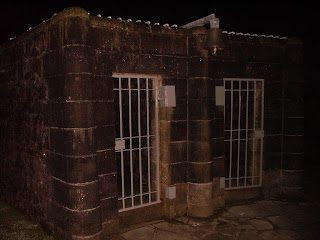
Located on the shores of Loch Fyne in the heart of Campbell country, Inveraray Jail was first opened for business in 1820 as a prison of eight cells, where both male and female criminals, and debtors, could be locked up after a trial in the adjacent courtroom. A new prison block with a further twelve cells was opened in 1848, and the whole operation continued until 1889 when it was finally closed. Having been to the prison several times before, it was never hard to imagine the horrendous lives of the prisoners who resided there. From a genealogical point of view, the museum also provides many useful resources for family historians, not least of which is its online database of prisoners located at http://www.inverarayjail.co.uk/our-history/, providing information on those convicted, their crimes and in some cases details of transportation, though it does not provide case notes for any of those said to still be haunting the place! Prisoners faced a gruesome time within, having limited facilities, poor food, a small courtyard for exercise, and the occasional whipping with the birch.

Arriving at the Jail at 10.00pm on the Saturday evening of the event, we were hastily gathered into a room for a briefing on the forthcoming six hour vigil, which initially started with some ‘training’. This was in the form of acquiring ‘protection’ against any prospective baddies out to get us through the vigil, mainly by imagining some sort of white light around us – an interesting start, I thought. We were divided into two teams, and our team, led by a lady called Linda claiming to be a medium, was soon being escorted to the prison’s new block.

Once inside, with all the lights switched off, Linda apparently began to sense the spirits of a John and Hugh Campbell pacing up and down their cell. They seemed fairly quiet to me, so instead I began to wonder what life must have been like each night for the prisoners, particularly in the winter with its short daylight hours. It was minus eight degrees outside, and not much warmer inside. As we left the ground floor, Linda announced that we were now being followed by a violent sheep stealer called Robert Stewart. Not one for having my sheep stolen, I quickly moved upstairs with everybody else. (In fact, a consultation of the database after the event did reveal that a person of that name from Glencoe was imprisoned in 1855 for 15 months for sheep stealing from three farms.)
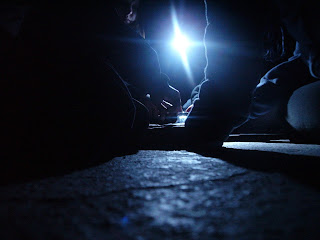
In an upstairs room, we were then asked to try to talk to spirits using a Ouija board. People get awfully spooked by Ouija boards, but not being a believer in the paranormal, I did not worry about having a go! I duly stuck my finger firmly on the glass, and after several minutes I was soon receiving the message loudly and clearly that my finger was getting very cold, but nothing more. Clearly 19th century prison discipline must have worked, because none of the spirits there were attempting to say boo to a goose.

But what about the notorious cell ten? A malevolent spirit was said to physically throw people from the single hammock fixed to its walls. We were all asked to squeeze in and a volunteer was asked for to lie on the bed. Too good an opportunity to put my feet up for a few minutes, I duly volunteered. I was surprised at how comfortable the bunk actually was, but sadly surprised by nothing more. I have to concede though that there is something distinctly surreal about lying on a bunk with ten people standing around you in the pitch black waiting for you to be violently attacked.

After swapping Linda for the organiser’s parapsychologist, we then proceeded to do an ‘EVP’ experiment. This involved asking three questions into a voice recorder, and leaving gaps in between. Once played back, some weird noises did emerge in the gaps. Some believed that these were spirits trying to break through, but I was not at all convinced.

The final event of the night, once again with Linda, was a visit to the court room. In total darkness we had to perform a role play, apparently seeing a trial underway may have excited spirits to come out and play! So rather bizarrely I suddenly found myself as the judge, standing beside the mannequin of the museum’s judge, sentencing some poor wee woman I had never met before in our team for having stolen her neighbour’s dog (I should add that no animals were harmed in the making of this production!). A séance was then held in the middle of the room. As one of the party excitedly yelled out “I challenge you in the name of God, and even he who cannot be named, to show yourself!”, my wife, a big fan of the Harry Potter books, looked to me and said “Who, Voldemort?”

So was it worth the visit? For me, nothing spooky happened, and as my wife put it, she went in a believer and came out a sceptic. But it was most definitely worth it to be allowed a free run around the museum and to experience it in a way that one normally cannot get the chance to. It was also a lot of fun. Would I go again? Definitely! And those ghosts know that this arrogant, sceptical genealogist has yet to be broken - they have as yet got everything to play for...!

Chris

Order Tracing Your Belfast Ancestors in the UK at https://bit.ly/BelfastAncestors. Also available - Tracing Your Irish Ancestors Through Land Records, Sharing Your Family History Online, Tracing Your Scottish Family History on the Internet, Tracing Your Irish Family History on the Internet (2nd ed), and Tracing Your Scottish Ancestry Through Church and State Records - to purchase, please visit https://bit.ly/ChrisPatonPSbooks. For purchase in tthe USA visit https://www.penandswordbooks.com. Further news published daily on The Scottish GENES Facebook page, on Threads at @scottishgenesblog and via Mastodon at https://mastodon.scot/@ScottishGENES.

Friday, 30 October 2020

Photographing spirits in Belfast in the 1920s

It's Hallowe'en, so it's time to wheel out the Ghostbusters in my family again...!

My two times great grandfather Edwin Graham was the Secretary of the Belfast Christian Spiritualist Association in Belfast in the 1920s. Edwin was a welder who married three times - first to Florence Halliday (my two times great grandmother), then briefly to Matilda Blair, and finally Sarah Stitt (with whom he is pictured from 1939). Sarah was said to be a 'gifted medium' from Liverpool.

In 1926 Edwin was involved in an extraordinary story in Belfast City Cemetery. Here's the story from the Irish Times:

Wednesday, July 28th 1926

PHOTOGRAPHING SPIRITS

Remarkable Service in Belfast Cemetery

Our Belfast correspondent states that unusual scenes were witnessed at a Service held yesterday at the City Cemetery under the auspices of the local Christian Spiritualists' Association. The Service took place around the grave of Mrs McDermott, mother of Mr John McDermott, medium of the Association, who died about three weeks ago. Upwards of a hundred spiritualists, some of them carrying cameras, wre present and during the singing photographs were taken. Mr McDermott conducted the Service, which consisted of prayer, singing and an address.

Mr. Edwin Graham, secretary of the Association, explained that the Service was purely evangelical, and that many photographs had been taken with the object of photographing the spirits of departed friends of persons present at the grave. "It is a very hard thing," he added "to obtain spirit photographs". He added that when the photographs were developed, in a day or two, they would know whether they had succeeded in their object. Mr Graham explained that a special Service for Mrs McDermott had been held previously in the Hall. She was a native of Glasgow but had been in Belfast for the past year.


The Northern Whig newspaper followed up the story on 18 AUG 1926:

"SPIRIT PHOTOGRAPHY"
     
CLAIM TO HAVING PHOTOGRAPHED THE DEAD
     
Strange Belfast Experiment
     
"I am perfectly satisfied that we have succeeded in taking photographs of those who have passed out of the body or who are what is commonly called dead."
     
This remarkable statement was made to a Northern Whig reporter yesterday by Mr John McDermaid, president of Ulster Christian Spirtualist Association.
     
The photographs on which the astonishing claim is based were taken recently by Mr Hugh Robinson as part of his investigation of Spiritualism in the Association's Hall, 63, Victoria Street, Belfast, and by the side of the grave of Mr McDermaid's mother in the City Cemetery.
     
Two of the prints were offered to the Northern Whig for publication, but were not suitable for reproduction. On the one of the graveside scene are three cloud-like effects, and on that showing the interior of the hall two similar effects.
     
Referring to the first print Mr McDermaid said:-"I can clearly identify my mother, and beside her is my little baby sister. There is also a vision of my father, Mr. Frank McDermaid, who passed out of the body 23 years ago. I can recognise their features with certainty. The other form on the print is a 'spirit cloud,' which comes as a spirit is beginning to manifest. If the exposure had been made a few moments later it is possible that the spirit form would have more completely developed and a more distinct impression would have been obtained. The three forms appear on the sky just above the heads of the people standing by the grave, and there must have been something there or nothing would have appeared on the photograph."
     
Mr. Edwin Graham, secretary of the Association, referring to the second print, declared:-"I am able to identify my brother, Thomas Graham, who passed out of the body 44 years ago. I recognise the hair, eyes and beard, and I have no doubt it is him."
     
Mr. McDermaid added that the taking of the photographs was simply an experiment, and he was much gratified that it had been successful. He regarded the results as furnishing additional proof of Spiritualism, and stated that he is prepared to allow any genuine investigator to see the photographs of (sic) make prints from the negatives.

This was not the only time that Edwin claimed to see his long-deceased brother. On October 15th 1932, Edwin wrote a letter to the Belfast Telegraph as part of an ongoing debate about the validity of spirit photography, in which he revealed his brother Thomas had again allegedly reappeared from beyond the grave in another photograph taken six years earlier:

VIEWPOINT OF READERS
     
SPIRIT PHOTOGRAPHY.
     
REMARKABLE EXPERIENCES.
     
LIKENESS OF LONG DEAD BROTHER.
     
Sir, Six years ago a floral service was held at our mission hall, 63 Victoria Street, Belfast, the platform of which was so tastefully decorated that three of our members volunteered to photograph it from different angles of the hall after the service. The results from two were fairly good, but the third (a 1/4 plate camera), to my astonishment, contained a very good likeness of my brother who "died" in 1882. Might I inform "Old Photographer" there was no "double exposures" or other fake methods used, as we merely tried to get the display of the beautiful decorations. Will "Old Photographer" please explain this occurrence, as there is no photo or painting of my brother in our possession. I would like to advise "Old Photographer" not to be so ready to rush into print regarding matters he knows nothing about, but try and investigate this wonderful mystery.
     
Yours etc.,
     
EDWIN GRAHAM, Belfast Christian Spiritualist Association.

I'm not a believer, but what was Edwin's motivation?. Did he see something genuine? Did he see what he wanted to see? Did he need to see something? Or was he simply spinning a yarn? Who knows what the camera may have picked up, but stories such as this certainly help to bring our ancestors back to life - it's one of the joys of genealogy.

Happy Hallowe'en - and to Thomas and Edwin, if there really is anything in this, I'm well up for a blether, and you know where to find me! :)

Chris

My next 5 week Scotland 1750-1850: Beyond the Old Parish Registers course starts November 2nd - see https://www.pharostutors.com/details.php?coursenumber=302. My book Tracing Your Scottish Family History on the Internet, at http://bit.ly/ChrisPaton-Scottish2 is now out, also available are Tracing Your Irish Family History on the Internet (2nd ed) at http://bit.ly/ChrisPaton-Irish1 and Tracing Your Scottish Ancestry Through Church and State Records at http://bit.ly/ChrisPaton-Scotland1. Further news published daily on The Scottish GENES Facebook page, and on Twitter @genesblog.


Wednesday, 28 October 2020

Scottish witches names on Ancestry

An updated post from a previous year, which may be of interest for Hallowe'en...

In 2016 Ancestry (www.ancestry.co.uk) released a special Scottish collection just in time for Hallowe'en.

Scotland, Names of Witches, 1658
http://search.ancestry.co.uk/search/db.aspx?dbid=61099
Source: Names of Witches in Scotland. Wellcome Library, London, England.

About Scotland, Names of Witches, 1658

The passing of the Scottish Witchcraft Act in 1563 made witchcraft, or consulting with witches, capital crimes in Scotland. It is estimated that between three and five thousand women were publicly accused of being witches in 16th and 17th century Scotland, a much higher number than neighbouring England. Some men were also accused of witchcraft during this period, however, the number of women persecuted was far larger.

The outbreak of witch-hunting in the years 1658-1662, the period in which this list of names was created, is generally agreed to represent the high water mark of Scottish persecution.

Within this collection, you will be able to find details of the accused's name and resident town.

(Image: Wellcome Library)


There is a bit more on the book's release on Scottish Legal news at http://www.scottishlegal.com/2016/10/27/book-listing-those-accused-of-witchcraft-in-17th-century-scotland-digitised/

Incidentally, I've noticed that the University of Edinburgh's Survey of Scottish Witchcraft website at http://witches.shca.ed.ac.uk (also https://www.shca.ed.ac.uk/Research/witches/) appears to be down - here's hoping it issn't permanent. There is more about the project at https://en.wikipedia.org/wiki/Survey_of_Scottish_Witchcraft

UPDATE: The site is back up!

Chris

My next 5 week Scotland 1750-1850: Beyond the Old Parish Registers course starts November 2nd - see https://www.pharostutors.com/details.php?coursenumber=302. My book Tracing Your Scottish Family History on the Internet, at http://bit.ly/ChrisPaton-Scottish2 is now out, also available are Tracing Your Irish Family History on the Internet (2nd ed) at http://bit.ly/ChrisPaton-Irish1 and Tracing Your Scottish Ancestry Through Church and State Records at http://bit.ly/ChrisPaton-Scotland1. Further news published daily on The Scottish GENES Facebook page, and on Twitter @genesblog.