Friday, 30 September 2022

Strathnaver Museum receives financial assistance

Sutherland based Strathnaver Museum (www.strathnavermuseum.org.uk), which is currently going through a refurbisment ahead of a relaunch in 2023, has received a loan of £600,000 from Scotland's richest man, Danish billionaire Anders Holch Polvsen. The loan will help to keep things ticking along whilst the museum overcomes a legal wrangle following the discovery that the deeds to the property remain in the names of the original community trustees and not that of Strathnaver Museum Ltd. 

The museum focusses on the history of the area, the Mackay clan, and the Highland Clearances (na Fudaichean) in the district.

For more on the story visit https://www.bbc.co.uk/news/articles/cgl0x83xe0zo and https://www.pressandjournal.co.uk/fp/news/highlands-islands/4853068/anders-povlsen-loan-to-strathnaver-museum/

Donations towards the refurbishment project can be made via the museum's home page.

Chris

My new book Tracing Your Irish Ancestors Through Land Records is now available to buy at https://bit.ly/IrishLandRecords. Also available - Sharing Your Family History Online, Tracing Your Scottish Family History on the Internet, Tracing Your Irish Family History on the Internet (2nd ed), and Tracing Your Scottish Ancestry Through Church and State Records - to purchase, please visit https://bit.ly/ChrisPatonPSbooks. Further news published daily on The Scottish GENES Facebook page, and on Twitter @genesblog.

Scotland 1750-1850 genealogy course starts October 17th

The next 5 week long Scotland 1750-1850: Beyond the Old Parish Registers course from Pharos Teaching and Tutoring Ltd commences on October 17th 2022 :

Scotland 1750-1850: Beyond the Old Parish Registers

This is an intermediate level course in Scottish family history for those who are going back beyond 1850. You should have some experience with research in the Old Parish Registers (OPRs) of the Church of Scotland and in using major websites for Scottish research.

This course discusses sources that fill the gap when the OPRs are uninformative or missing, such as the kirk session and presbytery courts records generated by the Kirk (Church of Scotland), as well as the records of dissenting and seceding Presbyterian congregations. From the forerunners of Scotlands modern towns and cities are the administrative records of the burghs, and the trades incorporations and merchant guilds, as well as other professions, which can enhance our understanding of our ancestors lives. And in the final two lessons the course turns up a notch and tackles two areas where the Scottish records, as generated through the feudal system, are truly unique, namely the various registers of land records known as sasines, and the separate legal processes in Scotland for the inheritance of both moveable and heritable estate.

Whilst some of the records discussed in the course are available online, many are available only in the archives, or in private hands; a strong focus of this course will be in how to successfully employ the relevant catalogues and finding aids to locate such treasures.

Whilst not compulsory, it is strongly recommended that you complete the Pharos course Scottish Research Online before studying Scotland 1750-1850: Beyond the Old Parish Registers, as it will be assumed that you are already familiar with the more basic resources available online for Scottish ancestral research.

Lesson Headings:

* Kirk Sessions records and parish poor
* Burgh records and town poor
* Occupations, taxation and early lists
* Land transfer and the value of sasines
* Land, inheritance and estates

Each lesson includes exercises and activities; a minimum of 1 one-hour chat session per week. (See How the Courses Work at https://www.pharostutors.com/howcourseswork.php.)

Relevant Countries: Scotland
Course Length: 5 Weeks
Start Date: 9 May 2022
Cost: £58

Student feedback from the most recent run of the course in Noivember 2021:

"The exercises helped you to explore new lesson concepts right away. Especially by directing students to apply new research aids to their own work."

"Very clear explanations of terminology and legal processes Really helpful exercises and comprenesive list of useful catalogues and other references Chat sessions very helpful and engaging."

"This being the second genealogy course I have taken, and the second with Pharos, I found these were detailed foundation courses which will permit me to search better and with less effort in my future research work."

"Great subject-matter and excellent tutor/written materials. It could not have been better."


The following video also gives a bit more of a flavour about what to expect:


(Available also at https://youtu.be/1vX6GZtwZJ0)

For further details, and to sign up, please visit https://www.pharostutors.com/details.php?coursenumber=302.

I'll hopefully see you online soon! 

Chris

My new book Tracing Your Irish Ancestors Through Land Records is now available to buy at https://bit.ly/IrishLandRecords. Also available - Sharing Your Family History Online, Tracing Your Scottish Family History on the Internet, Tracing Your Irish Family History on the Internet (2nd ed), and Tracing Your Scottish Ancestry Through Church and State Records - to purchase, please visit https://bit.ly/ChrisPatonPSbooks. Further news published daily on The Scottish GENES Facebook page, and on Twitter @genesblog.

Thursday, 29 September 2022

East Lothian Archives extends opening to 3 days a week from October 3rd

The John Gray Centre in Haddington has announced that East Lothian Archives will be extending its opening hours with a further day of opening each week. 

From next week (commencing October 3rd) it will be open on Mondays, Tuesdays and Thursdays from 10am-4.30pm.

For further details visit www.johngraycentre.org.

Chris

My new book Tracing Your Irish Ancestors Through Land Records is now available to buy at https://bit.ly/IrishLandRecords. Also available - Sharing Your Family History Online, Tracing Your Scottish Family History on the Internet, Tracing Your Irish Family History on the Internet (2nd ed), and Tracing Your Scottish Ancestry Through Church and State Records - to purchase, please visit https://bit.ly/ChrisPatonPSbooks. Further news published daily on The Scottish GENES Facebook page, and on Twitter @genesblog.

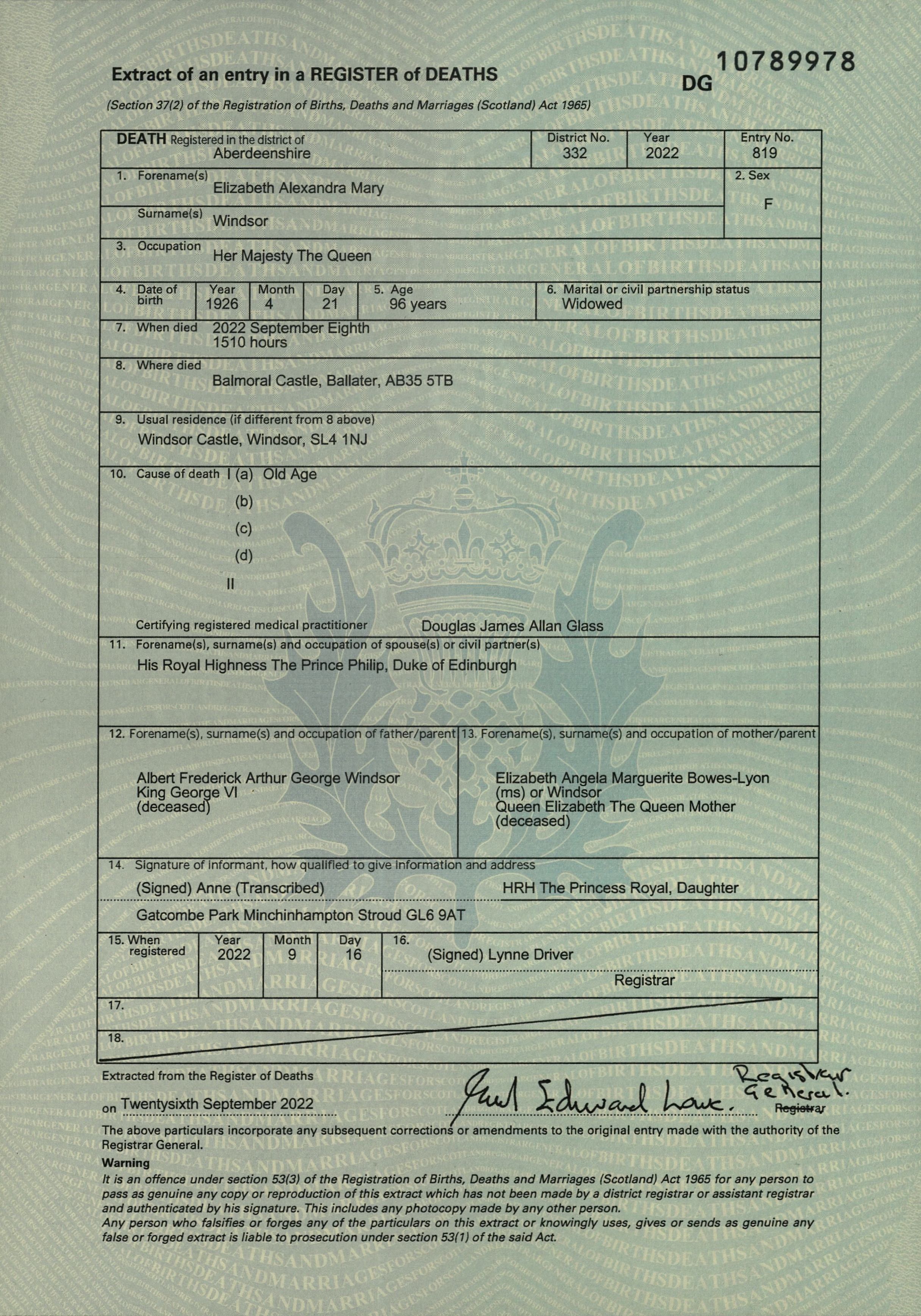
NRS reveals the Queen's cause of death was old age

The National Records of Scotland has revealed that the recent death of the Queen was due to 'old age', as recorded on her Scottish death certificate, with her occupation listed as 'Her Majesty the Queen', and the informant as her daughter, Anne.

To view a copy of the record, visit https://www.nrscotland.gov.uk/news/2022/registrar-general-releases-extract-of-death-entry-for-hm-the-queen and https://www.nrscotland.gov.uk/files//images/entry-in-the-register-of-deaths-hm-the-queen.jpg.


Chris

My new book Tracing Your Irish Ancestors Through Land Records is now available to buy at https://bit.ly/IrishLandRecords. Also available - Sharing Your Family History Online, Tracing Your Scottish Family History on the Internet, Tracing Your Irish Family History on the Internet (2nd ed), and Tracing Your Scottish Ancestry Through Church and State Records - to purchase, please visit https://bit.ly/ChrisPatonPSbooks. Further news published daily on The Scottish GENES Facebook page, and on Twitter @genesblog.

More on free to access content on the British Newspaper Archive

Although I have previously covered this from a Scottish and Irish perspective (see http://scottishgenes.blogspot.com/2022/09/a-further-million-free-to-view-pages-on.html), this is the press release from Findmypast which I have just received about the recent release of additional free to access content on the British Newspaper Archive site (www.britishnewspaperarchive.co.uk):

1 million pages of nation’s historical newspapers made free by British Library and Findmypast in digitisation project

  • 1 million pages of British Library’s vast historical archive added online for free by Findmypast
  • Most significant mass digitisation project of newspapers ever in UK, making over 300 years of nation’s history available to anyone, anywhere
  • Publications represent an unparalleled cultural resource to discover the UK’s colourful history in black and white
  • As trusted partners of the British Library, Findmypast are committed to making 5 million pages free over five years on the British Newspaper Archive and Findmypast Findmypast and the British Library have made one million pages of historical newspapers available online for free to the public, as part of a long-term partnership to improve the accessibility of these nationally important collections to people across the globe.


The additions mark a new milestone for the project of 2 million pages, with a goal of digitising and releasing five million free pages over five years. The newspapers are available online via Findmypast and The British Newspaper Archive (BNA) – a dedicated site created jointly by the British Library and Findmypast.

Much of this content has been made available as part of several major digitisation projects based at the British Library: 19th Century Newspapers; Heritage Made Digital, which seeks to transform digital
access to the British Library’s rare and early collections; and the Living with Machines research project, a collaboration between the British Library, The Alan Turing Institute and five partner universities, and funded by the Arts and Humanities Research Council (AHRC) via UK Research and Innovation’s (UKRI) Strategic Priorities Fund.

These free pages, covering the years 1699-1900 across 245 titles, increase the accessibility of historical newspapers to people around the world. The public can browse the beautiful images of the Illustrated London Life, discover their Scottish roots in the Glasgow Herald, or explore the history of Ireland with the United Irishman. One particularly intriguing title is Berthold’s Political Handkerchief, famously printed on calico, a type of fabric, in order to get around paying the newspaper stamp tax of the time. Also included are free pages of Welsh language titles Y Tyst and Y Llan, 22,113 pages from Northern Ireland and the Republic of Ireland, and 167,534 pages from Scotland, including the Edinburgh Gazette of 1699, the oldest newspaper digitised by the project so far.

Tamsin Todd, CEO at Findmypast said: "With free access to this unparalleled resource, Findmypast and the British library are offering the public unique opportunities to uncover the colourful stories behind historical events both great and small as they happened. Each page offers a snapshot of what life was like at that moment, documenting family stories, local legends and momentous events alike, transforming our understanding of both the past and the present. Some people will even discover their own ancestors hiding within these pages. I’d encourage everyone to go and explore this collection online, on the BNA or Findmypast.”

Xerxes Mazda, Head of Collections and Curation at the British Library, said: “We are delighted to be making a further one million pages from the British Library's newspaper collections available free to view online in conjunction with our digitisation partners Findmypast. Amongst the new resources available we have released over 200 regional newspaper titles from across the UK. Covering the years 1716-1900 and ranging from the Glasgow Herald and the Newcastle Courant to the Bristol Mercury and the Exeter Flying Post, these publications reflect the rich heritage of the UK’s media landscape and offer new opportunities for everyone to explore our collections from wherever they are the world.”

  • Other highlights of the release include: 
  • Friend of India and Statesman, 1852-1883 – published in Calcutta, this is another key title to support diverse research, continuing from the 2021 release of Royal Gazette of Jamaica and The Keys
  • Porcupine, 1800-1801 – its founder William Cobbett spent time in the United States in the 1790s and leant support to Alexander Hamilton’s Federalists. He was hailed as a ‘great British patriot’ on his return home
  • Francis’s Metropolitan News, 1895 – this family title showcased printer R.S. Francis’s ‘new style of illumination’, using blocks of colour to highlight sections
  • The Age, 1852-1853 – this title had a reputation for ‘scurrilous and satirical gossip’ about the celebrities of the day
  • The Anti-Gallican Monitor, 1811-1825 – this highly divisive newspaper called for the assassination of Napoleon Bonaparte, and provides an intriguing glimpse into attitudes towards France at the height of the Napoleonic Wars
  • The Patriot, 1832-1866 – this paper represented itself as a moral and philosophical repository for political thought, with its editor Matthew Campbell Browne hoping to influence the reform of Parliament and an equal Representation of the People.


Originally launched in 2011, Findmypast and the British Library’s partnership set out to digitise the British Library’s entire newspaper collection and open it up to the public as the British Newspaper Archive. Today, that contains over 50 million pages from over a thousand regional, national and specialty titles dating from 2009 all the way back to 1699. Its ever-expanding digital catalogue covers every corner of the British Isles as well as a number of former British territories including Canada, New Zealand, India, Pakistan, Barbados and Jamaica. 

(With thanks to Madeleine Gilbert) 

Chris

My new book Tracing Your Irish Ancestors Through Land Records is now available to buy at https://bit.ly/IrishLandRecords. Also available - Sharing Your Family History Online, Tracing Your Scottish Family History on the Internet, Tracing Your Irish Family History on the Internet (2nd ed), and Tracing Your Scottish Ancestry Through Church and State Records - to purchase, please visit https://bit.ly/ChrisPatonPSbooks. Further news published daily on The Scottish GENES Facebook page, and on Twitter @genesblog.

Tuesday, 27 September 2022

Ancestry adds UK, Coal Mining Accidents and Deaths Index, 1878-1951

Newly released on Ancestry (www.ancestry.co.uk):

UK, Coal Mining Accidents and Deaths Index, 1878-1951
https://www.ancestry.co.uk/search/collections/62506/
Source: Data compiled by Ian Winstanley ("The database that supports this index was created by Ian Winstanley for his website, The Coalmining History Resource Centre. The information in the database is derived from primary historical sources.")

UK, Coal Mining Accidents and Deaths Index, 1878-1951


General collection information

This collection documents the hazards of working in the coal mining industry during the late 19th and early 20th centuries. The index provides the names of people who were injured or killed while working in mines between 1878 and 1951. The entries for each person state whether the event was an injury or a death with a brief description of the event. They also include the miner’s place of residence, the date of the event, and the name of the employer. Some records also contain the miner’s birth year and occupation within the industry.

Using this collection

  • The index may include the following information:
  • Names
  • Event type
  • Date of the event
  • Residences of coal miners
  • Names of mine owners
  • Occupation
  • Birth year
  • Notes about the event


The information from this index could be used to verify that your ancestor was injured or killed while working as coal miner at a specific time during the late 19th and early 20th centuries. You may also discover the nature of the accident and how your ancestor was injured or killed.

NB: A few test searches shows many Scottish entries, with information about various incidents, but the source information for each entry is simply given as the Coalmining History Resource Centre, rather than the actual primary source. Further details might be obtainable from the centre or from newspapers (e.g. at the British Newspaper Archive at www.britishnewspaperarchive.co.uk), but it is also worth checking the Scottish Mining platform at www.scottishmining.co.uk, which has details of many accidents.

There is in fact a separate database on Ancestry from 2014 called UK, Coal Mining Accidents and Deaths Index, 1878-1935, again from the Coalmining History Resource Centre, located at https://www.ancestry.co.uk/search/collections/9735/. I suspect there will be a some duplication between the two databases.

Chris

My new book Tracing Your Irish Ancestors Through Land Records is now available to buy at https://bit.ly/IrishLandRecords. Also available - Sharing Your Family History Online, Tracing Your Scottish Family History on the Internet, Tracing Your Irish Family History on the Internet (2nd ed), and Tracing Your Scottish Ancestry Through Church and State Records - to purchase, please visit https://bit.ly/ChrisPatonPSbooks. Further news published daily on The Scottish GENES Facebook page, and on Twitter @genesblog.

Thursday, 22 September 2022

WW2 - English and Welsh Women's Land Army cards added to Ancestry

Ancestry (www.ancestry.co.uk) has added a new collection for the Second World War: 

UK, World War II Women's Land Army Index Cards, 1939-1948
https://www.ancestry.com/search/collections/62020/
Source: MAF 421: Ministry of Food: Women's Land Army: Index to Service Records of the Second World War. Kew, Surrey, England: The National Archives.

General Collection Information

This collection contains records of employment for those who served in the Women’s Land Army (WLA) from 1939 to 1948. The Women’s Land Army was established to help the country boost its wartime food production. Records in this collection consist of index cards to Second World War service records and are usually handwritten and are organised alphabetically by last name.

Using this Collection

This collection includes the following details:

    Name
    Any known aliases, including maiden names
    Address
    Employment county
    Employment place
    Birthdate
    Age at enrollment
    Date of enrollment
    Occupation
    Date of employment
    Date of release
    WLA membership number


Comment: This is a collection for folk who worked in England and Wales, rather than in Scotland, but there are some Scots and Northern Irish folk listed as working down south, but with a noted residential address back home. TNA have produced a short guide at https://www.nationalarchives.gov.uk/about/news/womens-land-army-index-cards-online-at-ancestry/.

Various records for the equivalent Scottish Women's Land Army are held at the National Records of Scotland, such as those for the Timber Corps, catalogued under AF59/285/1, and further Women's Land Army index cards for service records at AF59/285/1. From the NRS catalogue:

AF59/285/1 (Women's Land Army: Timber Corps)
"Index cards to service record files, arranged alphabetically. The cards give the name, address, date of birth, enrolment number, dates of interview and enrolment, dates and locations of training and employment, date and reason for leaving, and any comments. [The service record files have not survived.]"

AF59/285/2 (Women's Land Army)
"The cards give the name, address, date of birth, enrolment number, dates of interview and enrolment, dates and locations of training and employment, date and reason for leaving, and any comments. [3 of the service files have been preserved at NRS (refs: AF59/245, AF59/246, and AF59/247) but the remainder have not survived.]"

Check the NRS catalogue for further details at www.nrscotland.gov.uk.


Chris

My new book Tracing Your Irish Ancestors Through Land Records is now available to buy at https://bit.ly/IrishLandRecords. Also available - Sharing Your Family History Online, Tracing Your Scottish Family History on the Internet, Tracing Your Irish Family History on the Internet (2nd ed), and Tracing Your Scottish Ancestry Through Church and State Records - to purchase, please visit https://bit.ly/ChrisPatonPSbooks. Further news published daily on The Scottish GENES Facebook page, and on Twitter @genesblog.

Tuesday, 20 September 2022

Three more parish returns found for 1766 Religious Census of Ireland

I had a quick Twitter exchange earlier today with Brian Gurrin (@BrianGurrin), following a post I had made about the latest Family Tree magazine, in which I have written about the new Virtual Records Treasury - you can read a sample of it at https://www.family-tree.co.uk/how-to-guides/virtual-record-treasury-of-ireland-a-look-at-the-1766-religious-census/, which looks at the 1766 Religious Census of Ireland.

Brian has just advised of a great wee find earlier today - three more parish returns have been identified from the 1766 census at PRONI in Belfast, all of them from north Wexford, near Gorey, with one of them being Ballycanew (will update when I get the other two names!). Although the census returns are purely statistical, as is the case with some of the surviving census material, it is still a testimony to the futility of assuming that when people say a record series is lost, that's it - there will always be someone around to prove otherwise!

A great deal of the 1766 census has been reconstructed by the Vrtual Treasury, including many parishes with returns naming individuals - you can search it at https://virtualtreasury.ie/gold-seams/1766-religious-census


Update: The returns are for Kiltennel (https://virtualtreasury.ie/item?isadgReferenceCode=PROI%20PARL%2088%2F30%2F5%2F81%2F1%2F1316), Ballycannew (https://virtualtreasury.ie/item?isadgReferenceCode=PROI%20PARL%2088%2F30%2F5%2F81%2F1%2F1290) and Gorey (https://virtualtreasury.ie/item?isadgReferenceCode=PROI%20PARL%2088%2F30%2F5%2F81%2F1%2F1313), all in north Wexford. The information was originally transcribed/extracted by Tennison Groves.

With thanks again to Brian!

Chris

My new book Tracing Your Irish Ancestors Through Land Records is now available to buy at https://bit.ly/IrishLandRecords. Also available - Sharing Your Family History Online, Tracing Your Scottish Family History on the Internet, Tracing Your Irish Family History on the Internet (2nd ed), and Tracing Your Scottish Ancestry Through Church and State Records - to purchase, please visit https://bit.ly/ChrisPatonPSbooks. Further news published daily on The Scottish GENES Facebook page, and on Twitter @genesblog.

Monday, 19 September 2022

PRONI stakeholder forum news from Belfast

Last Friday I attended the the latest virtual stakeholder forum meeting at PRONI (www.nidirect.gov.uk/proni). Here are the latest developments...

Stephen Scarth advised us that PRONI would be closed today (Monday) for the Queen's funeral, and reopened as normal tomorrow (Tuesday). As a consequence of the monarch's death the PRONI social media accounts have been largely silent during the official mourning period, as per all services from the NI civil service. The very good news is that PRONI expects to be heading back to almost pre-pandemic service level normality by the end of this month (September). The only real question mark has been over late night openings on Thursdays once again, which is still being considered. 

As a consequence of Covid, visitor numbers are still down on pre-pandemic numbers, as folk find their way back to a new normality. Most events continue to be held online, which has actually boosted the numbers of attendees, a method which PRONI is keen to continue to employ due to its increased reach. There will be some on site events, but hybrid events are not quite as easy to organise. Forthcoming events are listed at https://www.nidirect.gov.uk/articles/talks-and-events-proni.

The PRONI director's position has been vacant for several months since the start of this year, with various folks taking on the responsibilities in short stints. As of this week it is hoped to have a temporary promotion in place for a member of staff to take on the role for a 3-4 month period, to provide a bit more continuity until a permanent appointee is made. 

Laura Aguiar from the Nerve Centre's CollabArchive project advised us that a dedicated site is now up and running at www.collabarchive.org featuring the five projects funded by National Lottery Heritage funding. Records that have been digitised for this project will be added to the PRONI catalogue, and the transcriptions created by the initiative will be added to the descriptions of the records, making them searchable. Dr. Patrick Fitzgerald from the Mellon Centre for Migration Studies at Omagh (https://mellonmigrationcentre.com) noted that collaboration on the 'Leaving. Crossing. Arriving' project had been a very rewarding experience, a view reciprocated by Laura. The CollabArchive project is nearing the end of its funding, but it is hoped that further similar projects can be considered in the future.

There was no update on the latest PRONI cataloguing efforts at this meeting. Work continues on the new onsite catalogue - this won't affect how the online catalogue works, but when visiting onsite it will look quite different to the current system in use there.

Next year sees the 100th anniversary of the founding of PRONI, with an almost year long commemorative programme from June 2023 to March 2024. PRONI is seeking opportunities to work with partners to help celebrate its foundation, and has held initial talks with several. There will be a launch event on June 30th 2023, in the same month as the 25th anniversary of the Good Friday Agreement. One major event for PRONI will be hosting the Archive and Records Association (ARA) conference in August 2023. 

A bit of progress on new records also. I previously reported that PRONI had been working on an index to its digitised Northern Irish tithe applotment book records. This work was an expansion of an index created by a member of the public, which is being enhanced. Things had been quiet on this front for a few months as PRONI switched its efforts back to opening its facility again to the public after lockdown - however, PRONI is now once again working on these records, which will be made available to the public at some stage. 

There is no further progress as yet on the upload of the wills calendars database extension, which will take the collection past 1965 as a cut off point (for complicated reasons to do with how the parent department makes updates to its resources online).

(With thanks to Stephen and Laura)

Chris

My new book Tracing Your Irish Ancestors Through Land Records is now available to buy at https://bit.ly/IrishLandRecords. Also available - Sharing Your Family History Online, Tracing Your Scottish Family History on the Internet, Tracing Your Irish Family History on the Internet (2nd ed), and Tracing Your Scottish Ancestry Through Church and State Records - to purchase, please visit https://bit.ly/ChrisPatonPSbooks. Further news published daily on The Scottish GENES Facebook page, and on Twitter @genesblog.

Saturday, 17 September 2022

PRONI will be closed on Monday 19th September

The Public Record Office of Northern Ireland (www.nidirect.gov.uk/proni) will be closed on Monday, and will re-open again on Tuesday at 9.30am.

(* I'll blog a report on yesterday's PRONI stakeholder forum meeting tomorrow!)

Chris

My new book Tracing Your Irish Ancestors Through Land Records is now available to buy at https://bit.ly/IrishLandRecords. Also available - Sharing Your Family History Online, Tracing Your Scottish Family History on the Internet, Tracing Your Irish Family History on the Internet (2nd ed), and Tracing Your Scottish Ancestry Through Church and State Records - to purchase, please visit https://bit.ly/ChrisPatonPSbooks. Further news published daily on The Scottish GENES Facebook page, and on Twitter @genesblog.